Korea's AI Consumption Trends and Success Stories
Last Updated: August 20, 2026
HooRii Technology’s AI interactive device “Clawstage,” already a hit on Kickstarter, launched a funding campaign on Wadiz and surpassed its funding goal by 146 times in less than ten days.
| Metric | Result |
|---|---|
| Funding Period | July 28 – August 17, 2026 |
| Amount Raised | 72,900,000 KRW |
| Achievement rate | 14,580% (about 146 times the goal) |
| Supporters | 145 |
This result wasn’t driven by overseas buzz alone. It stemmed from a shift in how Korean consumers are adopting AI, combined with the specific areas Clawstage chose to target within that shift. AI is changing how consumers everywhere interact with technology on a daily basis, and Korea is right at the center of that change. This article explores where Korea’s AI tech consumption trend is headed, how that trend is reflected in demand on Wadiz, and how Clawstage—a prime example of this trend—won over its supporters.
01. Korea’s AI Tech Consumption Trend: Rising Expectations
The world is focused on AI, and the center of gravity is shifting toward daily life
AI is the defining topic across the global tech industry in 2026. The core shift underway is that AI is moving out of massive cloud services and into devices that people own and use directly. If the AI race of the past few years was about who could build the biggest model, the race now is about who can actually run AI on the user’s device. Global tech companies racing to unveil personal AI agents and on-device AI technology are part of this same shift.

Korean consumers remain highly interested in AI products, even as concerns about privacy continue to grow
According to Opensurvey’s 2026 AI Appliance Trend Report, South Korean consumer expectations for AI appliances remain high at 82%. Usage has already reached 39% for AI kitchen appliances and over 51% for general AI home appliances. However, caution is also rising alongside adoption, driven by growing concerns over privacy and data collection. At the same time, consumers expect personalized experiences and greater efficiency from AI. Therefore, delivering clear daily benefits while explicitly addressing these privacy concerns will serve as a powerful competitive advantage when entering the South Korean market.
Despite these privacy concerns, South Korea remains exceptionally open to AI on a global scale. Among the 25 countries surveyed by the Pew Research Center, South Korea had the lowest share of respondents who were more concerned than excited about AI, at just 16%. This strong optimism suggests that Korean consumers are uniquely receptive to trying new AI products, making the market an ideal testing ground for foreign manufacturers.
02. Wadiz’s AI Tech Category: Where Early Adopters Validate First
How many AI projects have launched, and how much demand have they generated?
Wadiz is the premier destination for early adopters seeking the latest tech innovations. According to Wadiz internal data on Tech & Appliance projects launched between August 2025 and July 2026, over 100 projects featured “AI” directly in their titles, reflecting a sharp upward trend. Monthly launches surged from just two in August 2025 to ten by the end of the year, reaching a peak of 16 projects in May 2026. This steady growth throughout the first half of 2026 demonstrates that as more makers introduce AI products, the active supporter base is expanding right alongside them.
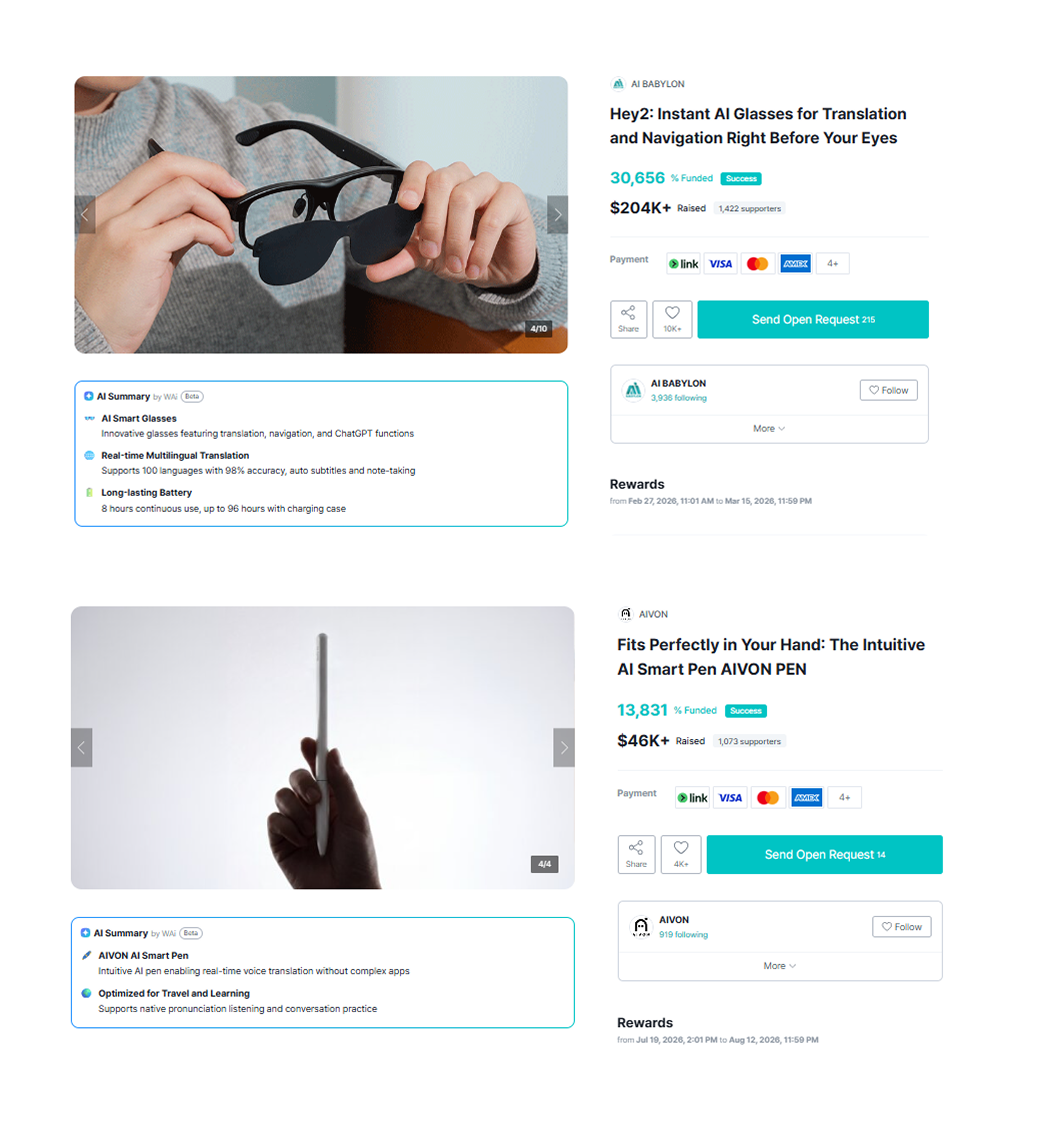
The products making a real impact span a wide range of categories. Diverse innovations—from AI glasses and smart AI pens to 140W AI chargers —have each attracted hundreds of supporters on Wadiz. However, products do not succeed simply by tagging “AI” onto their name. They draw a crowd only when AI directly addresses and solves a genuine pain point within that specific category.
03. Clawstage’s Success Strategy: What It Emphasized and Who It Targeted
Clawstage is an AI-powered interactive device that generated buzz on Kickstarter before launching on Wadiz. Its core design operates independently on the device itself without requiring a cloud server, allowing users to create an AI persona with the personality and appearance of their choice and connect it across multiple platforms. Its positioning reflects two key trends: on-device AI and the demand for AI that does not compromise personal data.
That positioning also appeals to a more specific consumer than “anyone interested in AI”—someone excited about what AI can do, but also uneasy about their conversations or daily-life data being transmitted elsewhere. Opening the campaign summary with “Standalone AI Interactive Device” was a deliberate signal to that exact audience: since the AI runs on the device itself rather than through a cloud server, a user’s voice, video, or interaction data does not need to be transmitted externally to reach an outside server.
Clawstage’s Success Strategy: Emphasizing Presence, Targeting Consumers Who Want a Character of Their Own
Clawstage did not target a broad audience of “anyone interested in AI.” Instead, it aimed at a far more specific segment: consumers already familiar with conversational AI and looking for a more personalized, physical interaction.
These consumers no longer want generic responses or an AI limited to text and voice on a screen. They want an AI with a physical presence and a tailored personality—one that feels like a real person.
By emphasizing a “personalized AI persona,” Clawstage highlighted that users can directly shape the device’s personality, appearance, and reactions. This goes beyond simply explaining a technical customization feature; it can strengthen a sense of personalization and ownership.

The storytelling strategies used to win over this audience were also concrete. First, naming the product “Personal AI Assistant That Comes Alive” immediately framed the device as a living presence rather than a mere tool. Adding “comes alive” drew a sharp distinction between static software and a physically reactive hardware device. Furthermore, leading the campaign summary with “real-time interaction and spatial awareness” consistently underscored that the product’s core value lies in its physical responsiveness.
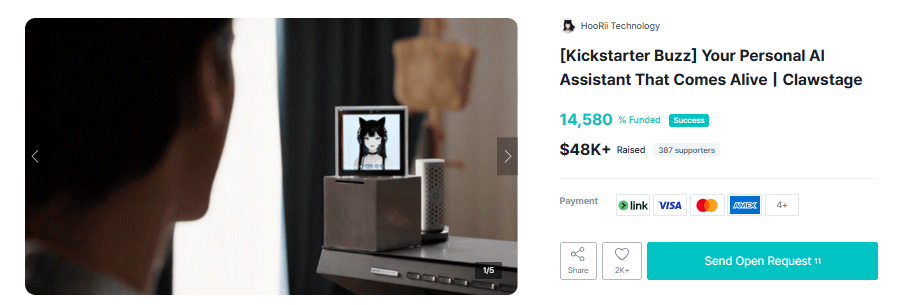
Second, relying on videos and GIFs rather than plain text descriptions was a direct extension of this strategy. Showing the device in action allowed backers to visualize themselves using it before making a purchase. Features that might have seemed abstract in static photos or text became intuitively clear through GIFs and real review footage, effectively helping backers understand how the device behaves in real-world use.
Finally, placing the Kickstarter buzz right at the forefront of the campaign title built instant credibility. Having already met the expectations set by overseas consumers lends a “proven choice” reputation to a brand that is relatively unfamiliar in Korea.
04. Key Takeaways for Global Makers
- South Korean consumers show relatively little concern about AI compared to other countries.
- AI-related project launches on Wadiz continued to rise throughout 2026, proving that supporter demand remains strong.
- If you already have traction overseas, leverage it early on, but pair it with a clear positioning statement rather than letting the buzz speak for itself.
- Show, don’t tell, when it comes to anything sensory. Videos and GIFs make the product experience easier to understand than written descriptions alone.
05. FAQ (Frequently Asked Questions)
Q. What happens if a crowdfunding campaign fails?
A. For unsuccessful funding projects, no payment charges are processed for backers.
- No funds are disbursed to the Maker. Since no payments are processed, there is no settlement amount.
- No Wadiz fees are charged. According to the guide, platform and settlement fees are fully waived when the funding goal is not reached.
- There are no additional penalties mentioned beyond not receiving the funds.
Q. Can I launch a project for a product that has already been sold elsewhere?
A. You can launch a project for a product that has been sold before, but it should be set up as a pre-order project rather than a new-product funding project.
On Wadiz:
- Funding is for products that have never been sold anywhere before.
- Pre-orders are for products that already have a sales history (sold or funded on your own website, other platforms, or overseas) and are being offered to Wadiz Supporters with Korea-first or platform-exclusive benefits (e.g., local-exclusive benefits, special bundles, limited editions).
So if your product has already been sold elsewhere, you can still launch it on Wadiz by selecting the “Pre-order” type when creating your project.
Just Get Started on Wadiz.
Your step-by-step guide from preparation to funding success—available now at the Wadiz Maker Center.