AI Consumption Trends in South Korea and Success Stories
Last Updated: August 20, 2026
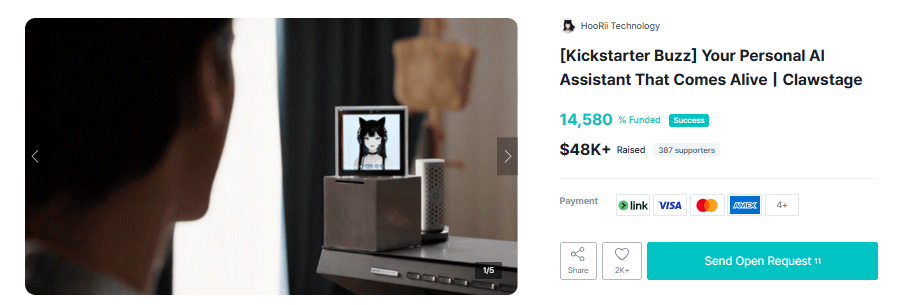
HooRii Technology’s AI interactive device, “Clawstage,” caused a sensation on Kickstarter and subsequently launched a crowdfunding campaign on Wadiz, where it reached 146 times its funding goal in less than ten days.
| Metrics | Results |
|---|---|
| Crowdfunding Period | July 28, 2026 – August 17, 2026 |
| Amount Raised | 72,900,000 KRW |
| Funding Rate | 14,580% (approximately 146 times the goal) |
| Number of Backers | 145 people |
This achievement wasn’t driven solely by overseas buzz. It stems from a shift in how South Korean consumers are embracing AI, and Clawstage happened to hit the sweet spot of this transformation. AI is changing the way consumers around the world interact with technology on a daily basis, and South Korea is at the center of this shift. This article will examine the direction of AI technology consumption trends in South Korea, how these trends are reflected in market demand on Wadiz, and how Clawstage—a prime example of this trend—succeeded in winning over its backers.
01. AI Technology Consumption Trends in South Korea: Expectations Continue to Rise
Global Focus on AI: The Shift Toward Everyday Life
In 2026, AI is the most central topic in the global tech industry. The core shift currently underway is that AI is moving out of massive cloud services and into devices that people directly own and use. If the core of the AI race in recent years was “who can build the largest model,” the core of the race now is “who can truly make AI run right by the user’s side.” Global tech companies are racing to launch personal AI assistants and on-device AI technologies, which is precisely part of this shift.

Even as privacy concerns continue to rise, South Korean consumers remain highly interested in AI products
According to the “2026 AI Home Appliance Trends Report” released by Opensurvey, 82% of South Korean consumers have high expectations for AI home appliances. The adoption rate of AI kitchen appliances has reached 39%,while the overall adoption rate of AI home appliances exceeds 51%. However, as adoption rates rise, consumer caution is also growing, primarily due to mounting concerns about privacy and data collection. At the same time, consumers expect AI to deliver personalized experiences and improve efficiency. Therefore, for startups entering the South Korean market, clearly addressing these privacy concerns while providing tangible, everyday value will be a powerful competitive advantage.
Despite these privacy concerns, South Korea remains a highly open market for AI on a global scale. Among the 25 countries surveyed by the Pew Research Center, South Korea had the lowest percentage of respondents who “have more concerns than expectations about AI,” at just 16%. This strong sense of optimism indicates that South Korean consumers have a unique openness to trying new AI products, making this market an ideal testing ground for overseas startups.
02. Wadiz AI Technology Category: A Place Where Early Adopters Lead the Way in Validation
How many AI projects have been launched? How much demand have they generated?
Wadiz is the platform of choice for early adopters seeking the latest technological innovations. According to Wadiz’s internal data, among the technology and home appliance projects launched between August 2025 and July 2026, more than 100 project titles directly included the word “AI,”showing a clear upward trend. The number of projects launched per month grew from just 2 in August 2025 to 10 by the end of the year, peaking at 16 in May 2026. This sustained growth in the first half of 2026 indicates that as more creators launch AI products, the active supporter base is expanding in tandem.
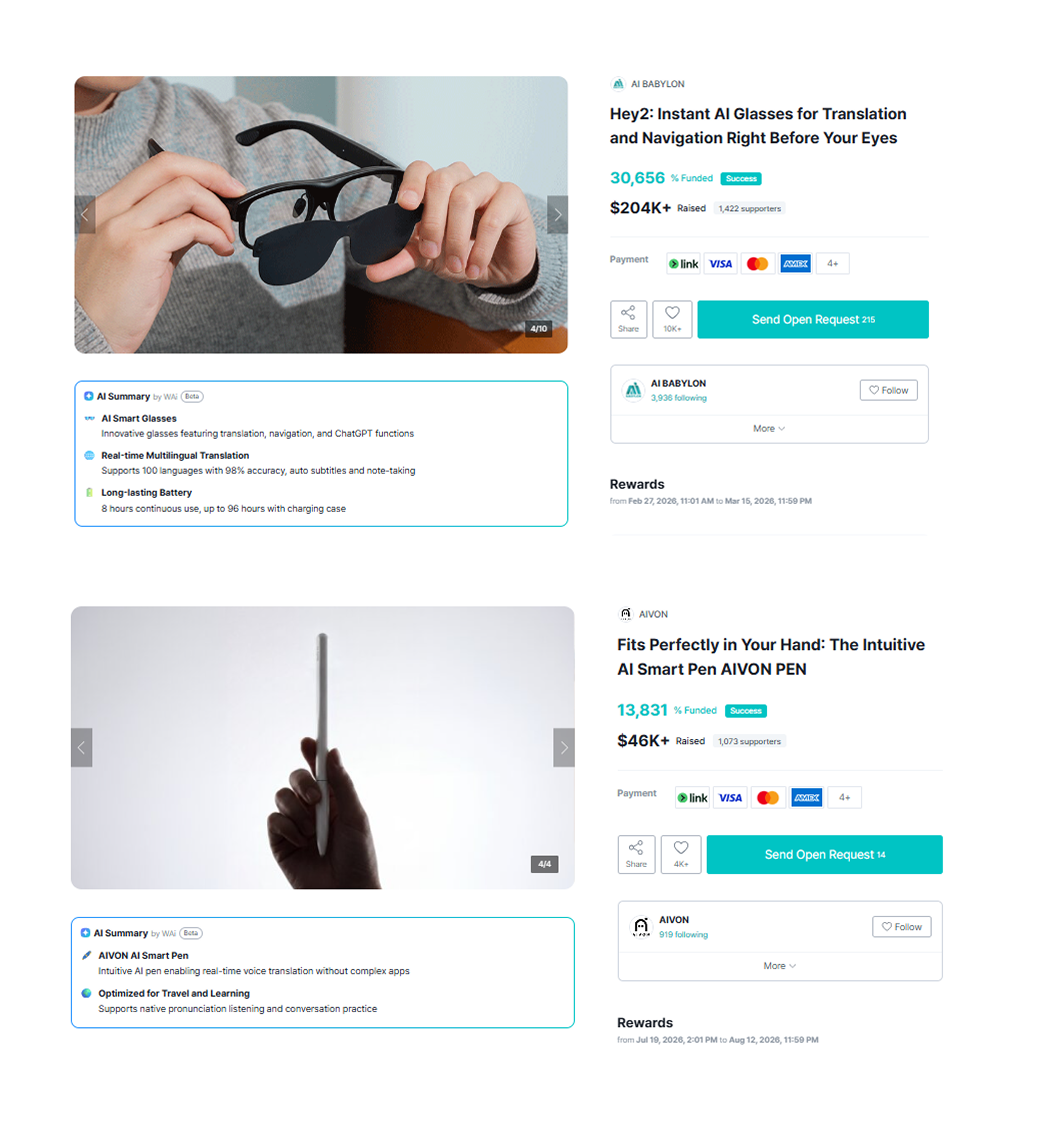
Products that have had a real impact span multiple categories.From AI glassesandsmart AI pens to 140W AI chargers, these diverseinnovative productshave attracted hundreds of backerson Wadiz. However, a product does not succeed simply by being labeled “AI.” It can only attract backers when AI truly solves a real pain point within that category.
03. Clawstage’s Success Strategy: What It Emphasized and Who It Targeted
Clawstage is an AI interactive device that generated significant buzz on Kickstarter even before launching on Wadiz. Its core design operates independently on the device itself without requiring cloud servers, allowing users to create personalized AI avatars with unique appearances and have them accompany them across multiple platforms. This positioning aligns perfectly with two major trends: on-device AI and the demand for AI that does not come at the expense of personal data.
This positioning also targets a more specific group of consumers than simply “anyone interested in AI”——those who are excited about what AI can do but are also uneasy about their conversations or daily data being transmitted elsewhere. Placing “standalone AI interactive device” at the very beginning of the event description was a deliberate design choice to precisely target this audience: since the AI runs directly on the device itself rather than via the cloud, users’ voice, video, or interaction data never needs to be transmitted to external servers.
Clawstage’s Successful Strategy: Emphasizing “Presence” and Targeting Consumers Who Crave a Personalized Personality
Clawstage did not target the broad demographic of “anyone interested in AI,” but rather focused on a more precise segment: consumers who are already familiar with conversational AI and crave a more personalized, tangible interactive experience.
These consumers are no longer satisfied with cookie-cutter responses or AI confined to on-screen text and voice. What they want is an AI with a tangible presence and a customizable personality—an entity that feels like a real person.
By emphasizing a “personalized AI personality,” Clawstage conveys that users can directly shape the device’s personality, appearance, and responses. This goes beyond a simple description of technical customization features and is more likely to reinforce users’ sense of personalization and “ownership.”

The storytelling strategy to win over this audience is equally specific. First, naming the product “a personal AI assistant that awakens” immediately positions the device as a living, breathing entity rather than a mere tool. The addition of the term “awakens” clearly distinguishes it from static software and highlights its status as a hardware device capable of physical responses. Furthermore, opening the campaign description with “real-time interaction and spatial awareness” consistently emphasizes that the product’s core value lies in its physical responsiveness.
Second, the campaign’s heavy reliance on videos and GIFs—rather than purely text-based descriptions—is a direct extension of this strategy. Showing the device in action allows backers to visualize themselves using it before making a purchase. Features that might seem abstract in static images or text become intuitive and easy to grasp through GIFs and real-world usage footage, effectively helping backers understand how the device performs in practice.
Finally, placing the product’s popularity on Kickstarter right at the beginning of the campaign title quickly established trust. The fact that it has already been tested by international consumers gave this brand—which is relatively unknown in South Korea—the trusted label of a “proven choice.”
04. Key Points for Global Makers
- Compared to other countries, South Korean consumers have relatively low levels of concern regarding AI.
- Throughout 2026, the number of AI-related projects launched on Wadiz continued to climb, proving that demand from supporters remains strong.
- If your project is already generating buzz in overseas markets, you should capitalize on that momentum as soon as possible—but be sure to pair it with a clear positioning statement rather than relying solely on the buzz itself.
- For any content that appeals to the senses, a demonstration is better than a description. Compared to simple text descriptions, videos and GIFs make the product experience easier to understand.
05. Frequently Asked Questions
Q. What happens if the crowdfunding campaign fails?
A. For crowdfunding projects that do not meet their funding goals, no payments will be processed from backers.
- No payments will be processed for creators. Since no payments are generated, there are naturally no settlement amounts.
- No Wadiz platform fees will be charged. According to the guidelines, if the crowdfunding goal is not met, platform fees and settlement fees will be fully waived.
- Apart from not receiving funding, there are no other penalties.
Q. My product has already been sold elsewhere. Can I still launch a project on Wadiz?
A. You can launch a project for a product with a sales history, but you should selectthe “Pre-order”type rather than the “Funding” type, which is intended for brand-new products.
On Wadiz:
- Crowdfunding (Funding) applies to products that have never been sold through any channel before.
- Pre-order applies to products with a sales history (those previously sold on the company’s own website, other platforms, or overseas, or that have been crowdfunded) and are offered to Wadiz supporters as a South Korean exclusive launch or platform-exclusive benefits (such as local-exclusive discounts, special bundles, limited editions, etc.).
Therefore, even if your product has been sold elsewhere, you can still launch a project on Wadiz by selectingthe “Pre-order”type when creating your project.
Get started right now on Wadiz.
A step-by-step guide from preparation to successful fundraising—now available on the Wadiz Maker Center.