[Content Director’s Column #10] How to Write Ad Copy in 10 Minutes Using ChatGPT
This content is
Episode 10 of the <Content Director’s Column>
series.
Be sure to take this with you!
- I’ll show you how to write ad copy using ChatGPT, which has now become part of our daily lives.
- Prompts? Commands? No complicated jargon—even beginners can follow along.
- I’ll focus on how to collaborate with ChatGPT rather than simply relying on it.
This copy was written in just
in just 10 minutes.
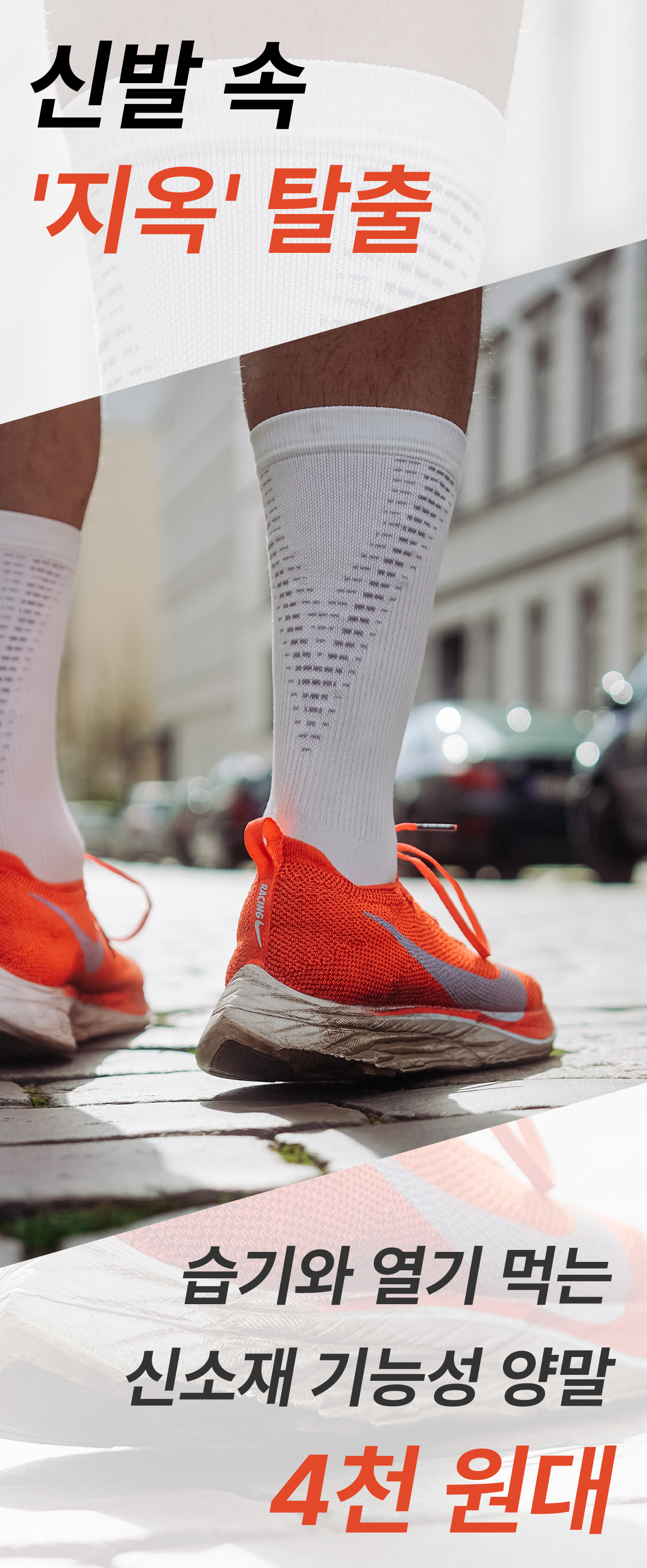
Product information?
None.
The author arbitrarily imagined a very broad product category called “functional sports socks.” It was a product that existed only in the author’s mind, but ChatGPT gave it concrete characteristics such as breathability, absorbency, moisture-wicking, durability, and fit.
The product’s target audience?
None.
The more vague a product is, the harder it is to identify a specific target audience—a problem that anyone working in content creation has undoubtedly encountered. However, even with anextremely vague, even fictional productlike “functional sports socks,” ChatGPT easily identified five specific target audiences.
The product’s concept?
None.
“Escape from Hell Socks.” It’s a product concept that will easily stick in the minds of any customer who reads it. If a content marketer or copywriter had been assigned the task of “coming up with a concept by tomorrow” without any product features or target audience, they might have been forced to work late into the night and even shed a few tears.
ChatGPT provided the brilliant phrase “Escape from Hell” in less than 10 minutes. The content director then fleshed it out and added visuals, giving birth to that stunning ad image.
The more you work in content,
the more they need to quickly embrace ChatGPT.
For a while, news article headlines
were flooded with ChatGPT-generated headlines.
Back then, content directors like me—who plan and write content—thought we’d be laid off within a day or two. Fortunately, we haven’t been laid off yet, and the intense interest in ChatGPT has temporarily subsided.
Still, I’m afraid. Unlike the technologies of the past that emerged in the name of innovation only to disappear without a trace, ChatGPT seems to be merely “taking a breather”—as if it’s gathering its strength for another leap forward. It’s true that content directors—who lack the ability to learn and appropriately combine trillions of advertising copy examples like ChatGPT does, and instead rely solely on momentary ideas, experience, and intuition to craft a single piece of copy—are facing an existential threat.
ChatGPT’s Data + Human Ideas
= The Future of the Content Industry
That’s why I suspect that content industry professionals are the ones actively adopting ChatGPT into their workflows more than anyone else. Just as the flavor of the same beef seasoned with the same types of salt and pepper can vary infinitely depending on the amount and ratio of those ingredients, we can now produce even better results in less timeby adding just a “gram” of our own ideas to the “historical data” ChatGPT has learned.
Above all, we know all too wellthe outcome of the Luddite movement* some 200 years ago—which is why we can’t afford to reject new technology simply out of fear.
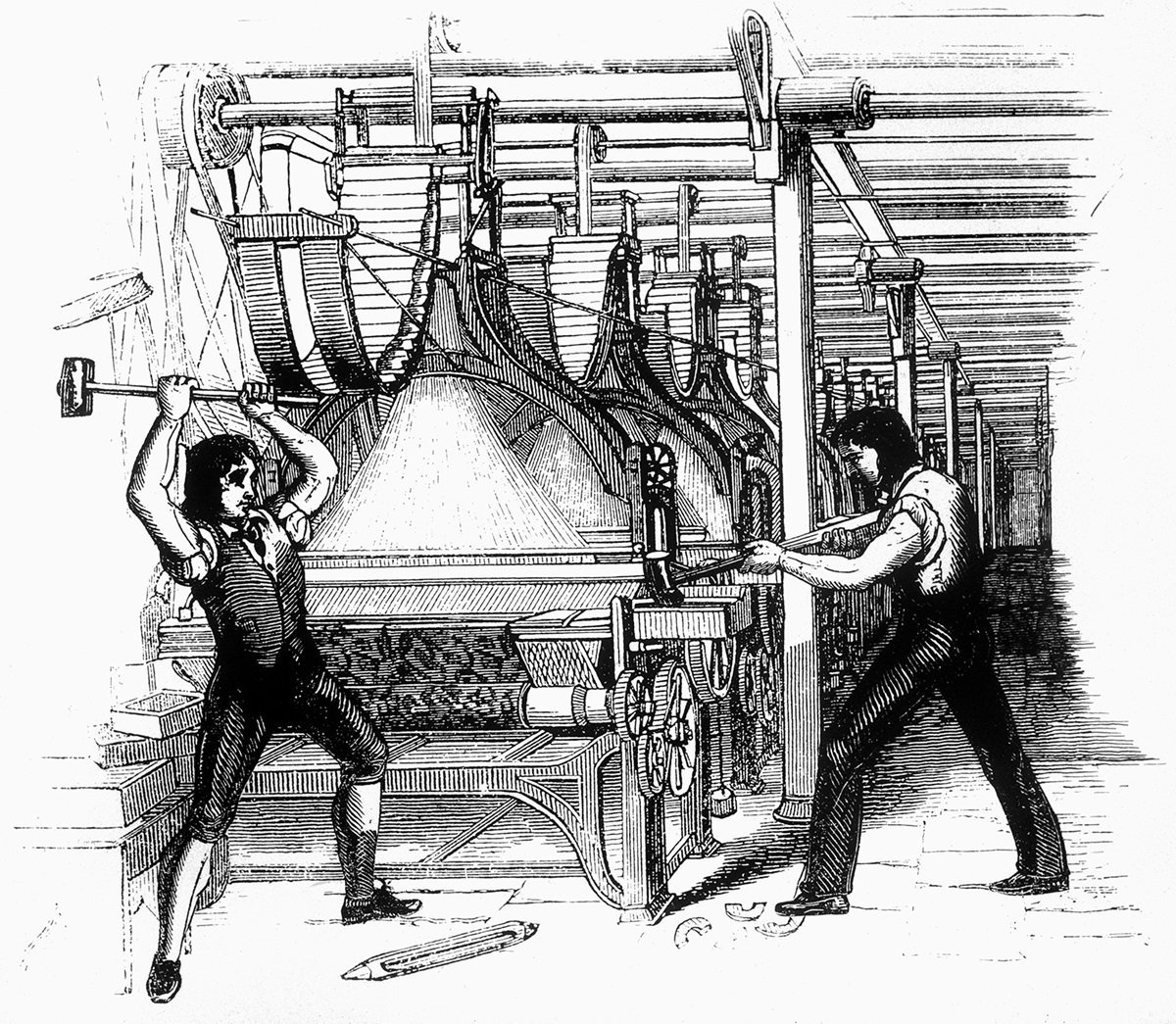
*Luddite Movement:A workers’ movement to destroy machinery that took place in Britain from 1811 to 1817.
As machines introduced by the Industrial Revolution gained the upper hand, workers—facing harsh working conditions and poor labor environments at the time—organized under the leadership of N. Ludd to systematically destroy machinery. While this may have influenced improvements in working conditions and the environment, it did not stop industrialization and automation.
The Content Director
Reveals How to Write Copy Using ChatGPT
I’ll explain how I createdthe copy “Escape the ‘Hell’ in Your Shoes! New-Material Functional Socks That Absorb Moisture and Heat, Priced Around 4,000 Won” in just 10 minutes without relying entirely on ChatGPT.
Collaborate with ChatGPT,
but don’t depend on it
First, let’s look at the big picture of how this collaboration with ChatGPT unfolded. It’s divided into six main steps.

One, Establishing Context
Toget specific,more “human-like” responses from ChatGPT, you’ve probably heard. Since you need to write ad copy, simply think of a profession that would typically write ad copy and ask ChatGPT to assume that role.
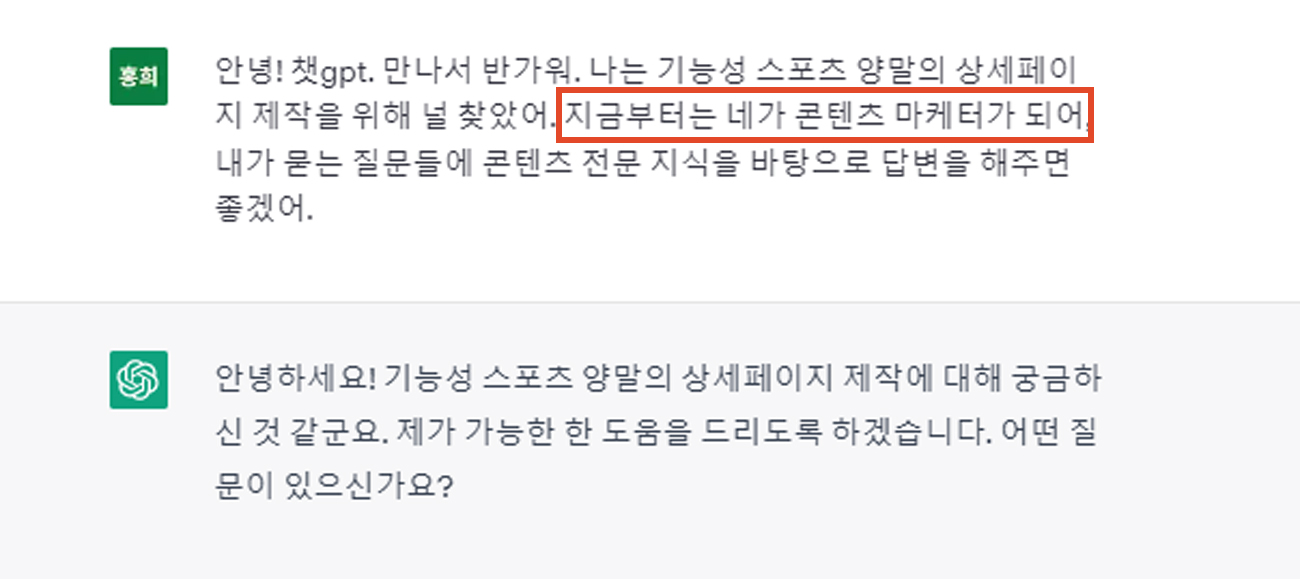
While it’s best to be specific and precise with the job title, it’s also possible to write something general—like “content marketer,” as I did—and then add the details you want.
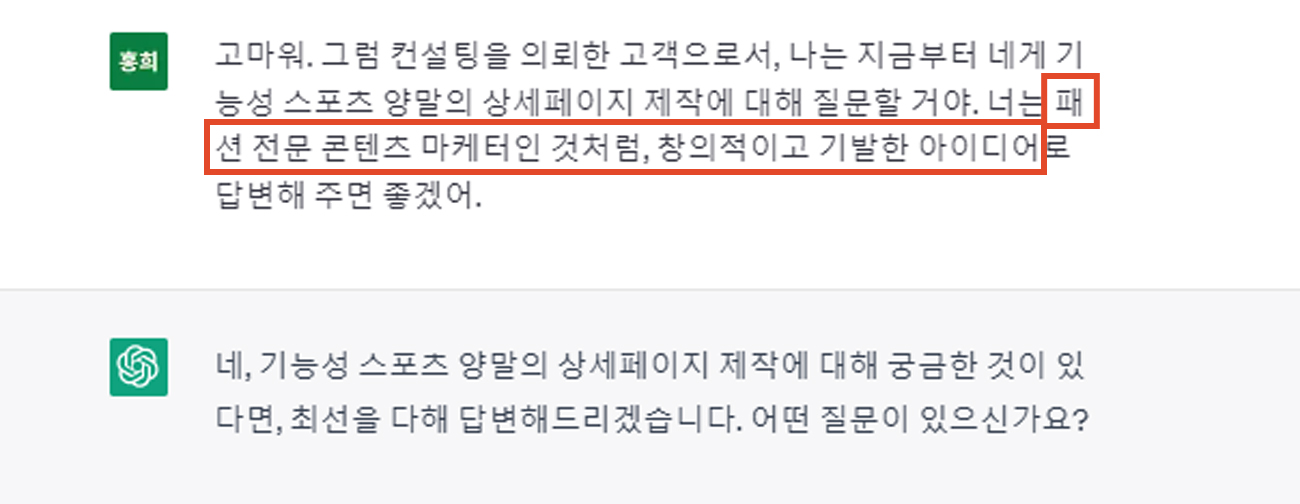
Also, be sure to check whether ChatGPT has properly understood its role. Although this is a simple verification step, it can help reinforce ChatGPT’s understanding of its role, even if only slightly.
Second, Identify Your Target Audience
Questions that are too broad—such as “Tell me the target audience for functional sports socks”— aren’t very helpful.ChatGPTmight not fully grasp the context and end up providing similar answers. For example, from a content director’s perspective, people who enjoy exercise, athletes, and outdoor enthusiasts are all similar target audiences.
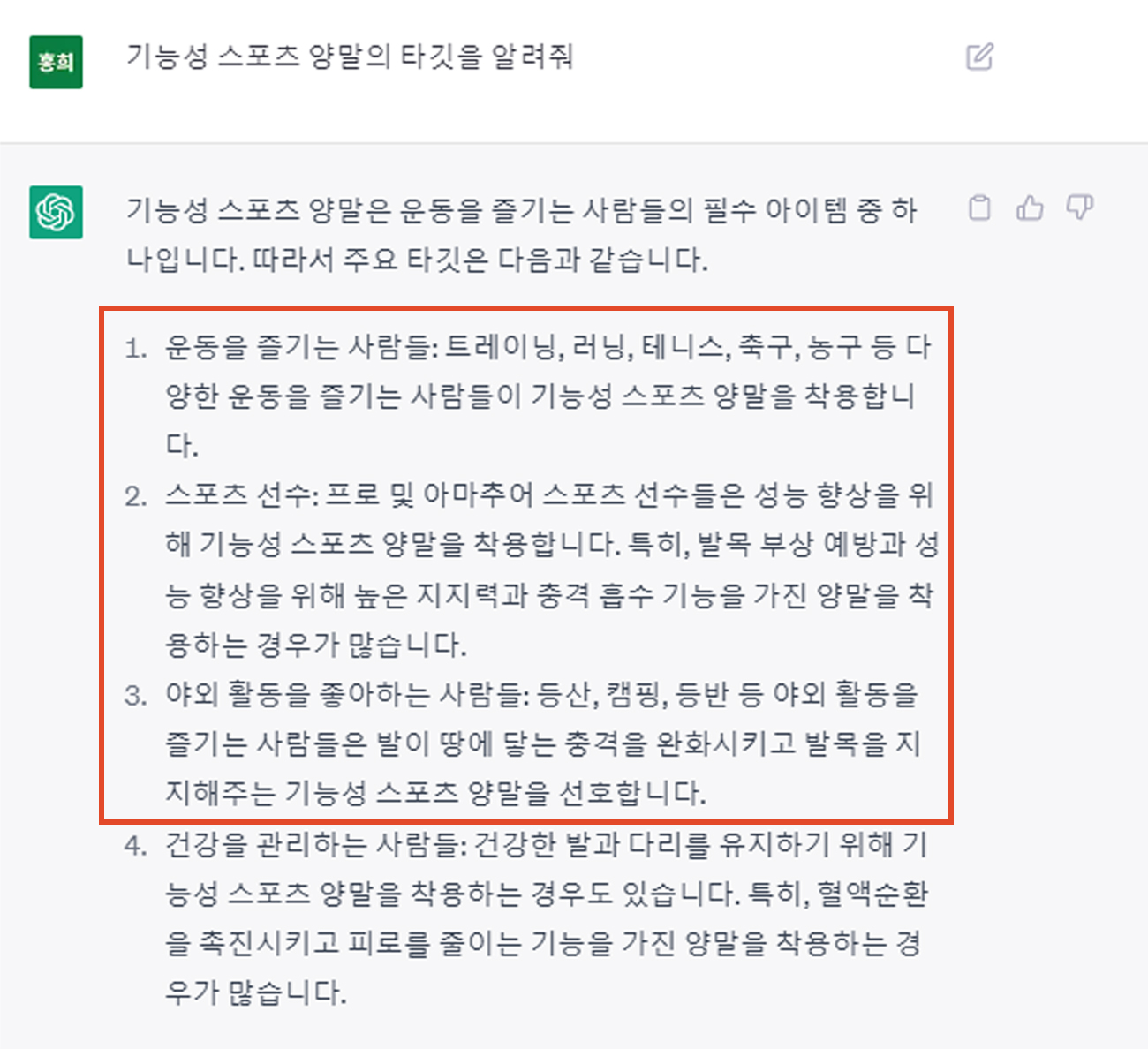
Since ChatGPT has been trained to sell as many products as possible as a content marketer, you should specify a concrete number—such as “five target audiences”—to help it identify them.
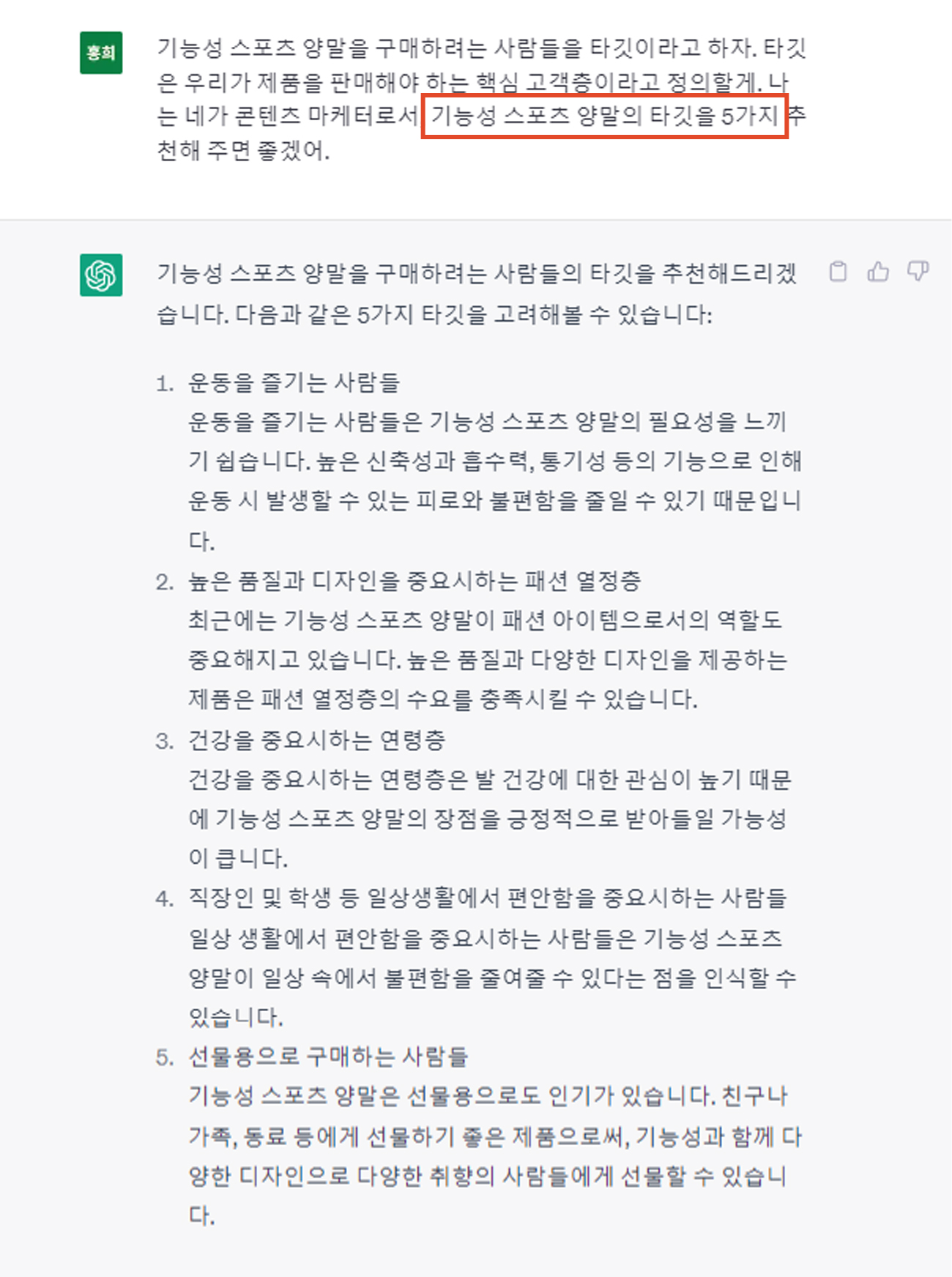
Third, Analyze Product Features
Now you need to analyze your product’s features. I recommend a reverse-engineering approach. Don’t start by telling ChatGPT what your product’s features are. If you do that, you’ll end up analyzing your product’s features from your own perspective—nothing more, nothing less. Even when using ChatGPT, you might not gain a significantly new perspective.
Therefore, select one of the target audiences derived from ChatGPT’s recommendationsand ask it, in reverse, which features would be most important to appeal to that specific audience.
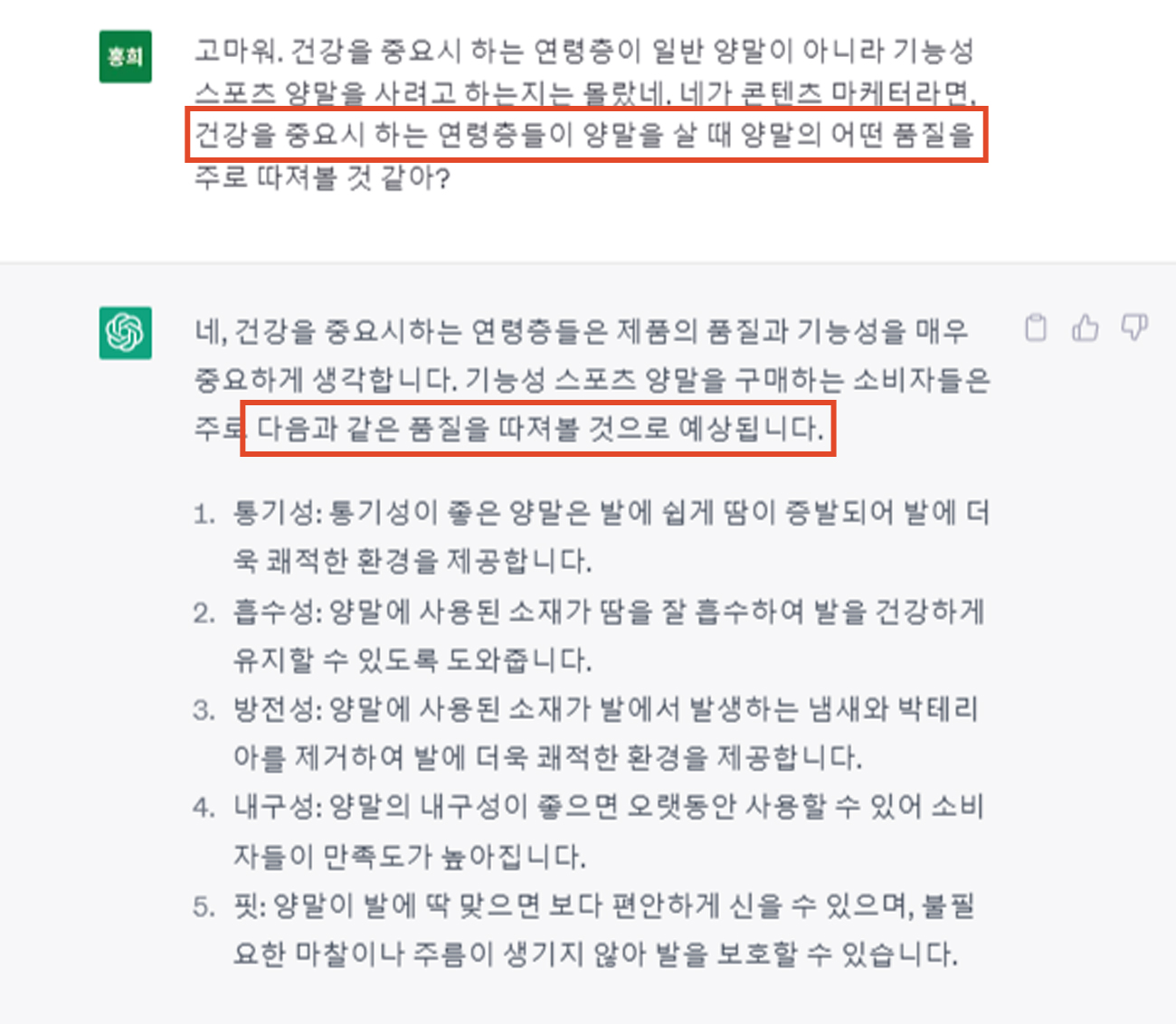
Just as with all product detail pages and ad copy, you shouldn’t tailor your product’s features to your target audience. Therefore, when communicating with ChatGPT , it’sbest tofollow this order : first identify your target audience, then ask for recommendations on the key features that resonate with each group.The smart ChatGPT will automatically explain why those features are appealing to your target audience.
Four, Highlight Different Product Features Based on Variables
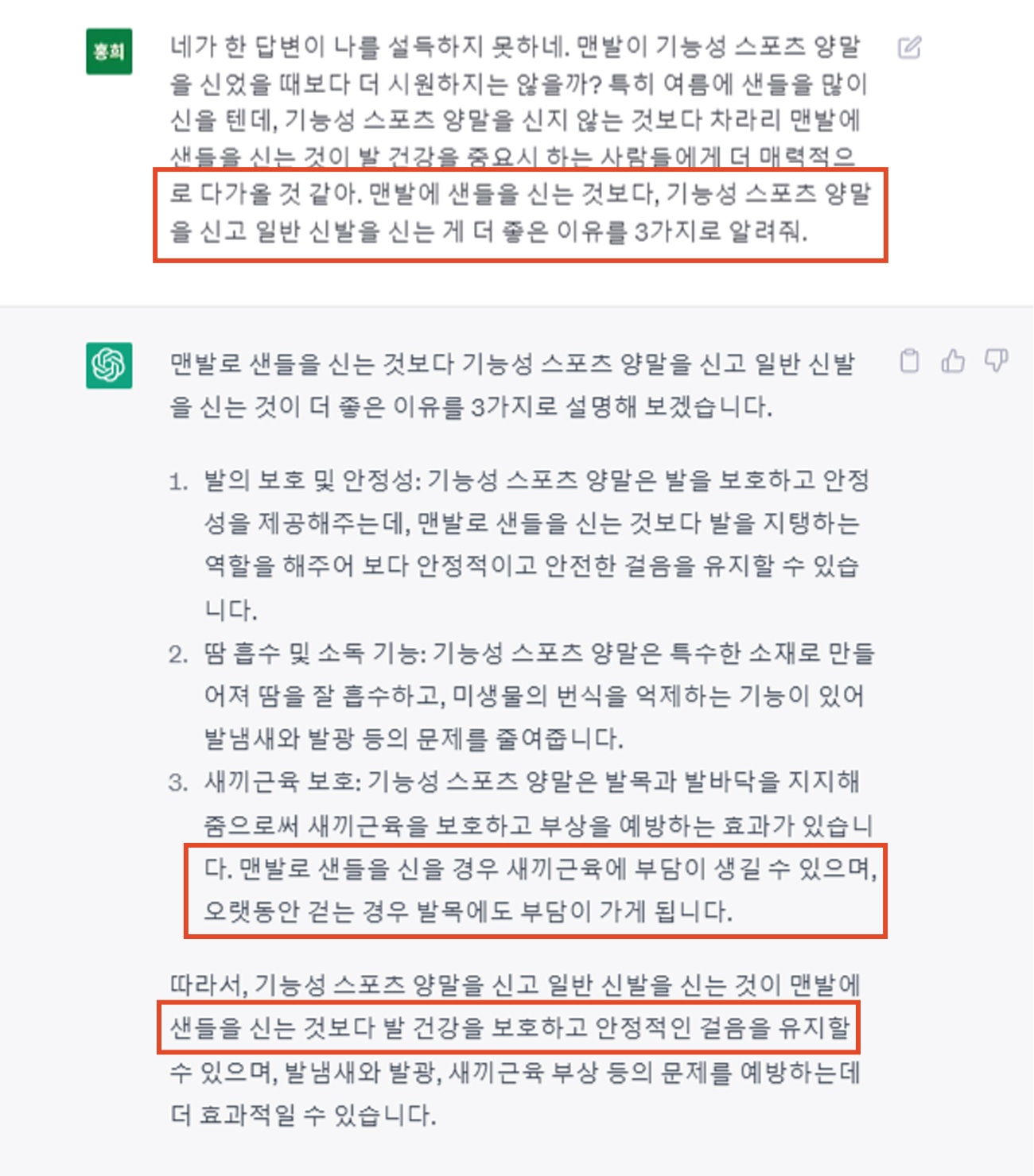
This is nearly the final step in writing ad copy. When crafting copy, it’s crucial to tap into seasonal themes or pain points that resonate specifically with your target audience. You need to set conditions so that ChatGPT can write copy that takes these factors into account.
Through this process , I—the user—can also naturally grasp what to consider when creating content.Without ChatGPT ,I would have simply listed my product’s advantages on the product detail page and called it a day. But thanks to ChatGPT, I was able to consider—right from the planning stage—the importance of wearing socks with shoes rather than just sandals in the summer.
Five: Commissioning Copywriting
Alright, now we have everything we need to write the ad copy. We’ve identified our target audience, understood their characteristics, and recognized the seasonal variables we need to consider. Since all this information was exchanged in a single conversation, ChatGPT already understands my intent and context.If I ask it to write the copy, it will generate copy tailored to my product.
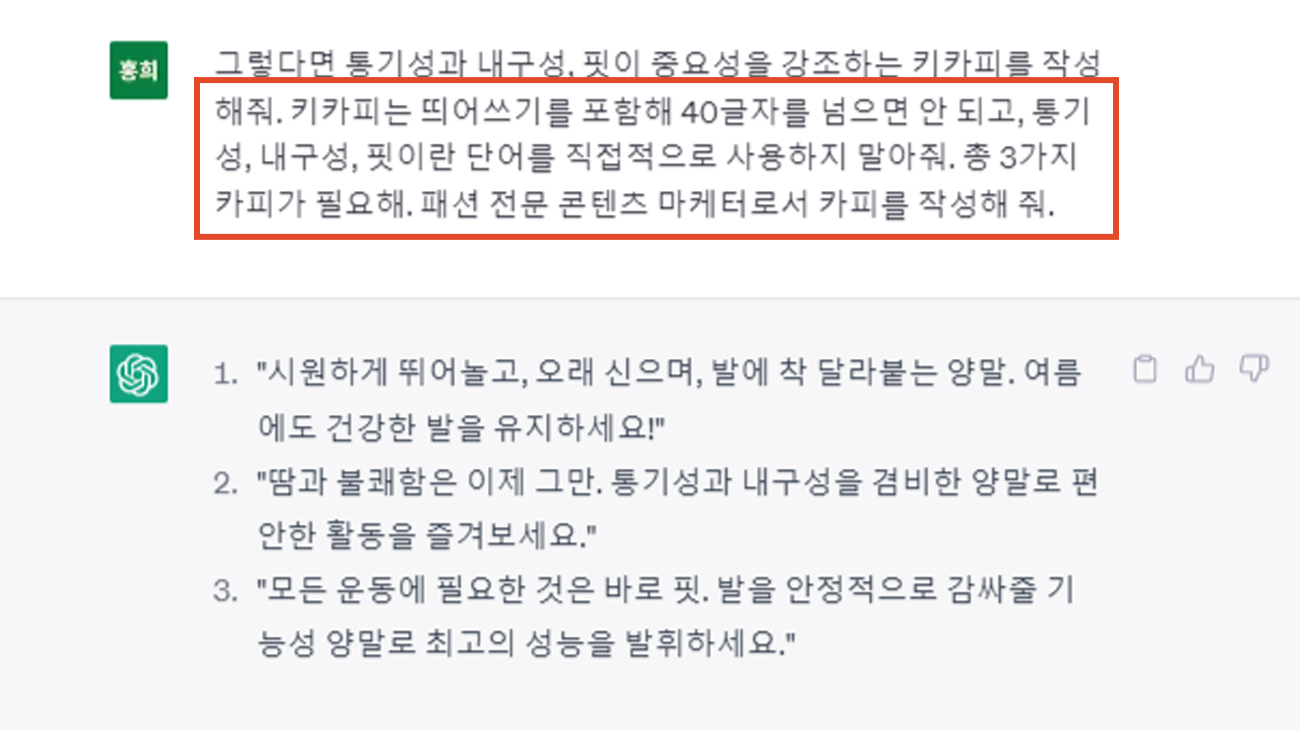
Even if that product is a fictional one that exists only in my imagination!
Six: Revise and Refine According to Your Desired Criteria
Of course, ChatGPT might not provide the perfect answer I’m looking for right from the start. In such cases, I need to repeatedly provide specific conditions and guide ChatGPT so it can revise the text on its own.
No matter which platform you use, there’s a character limit for product names or product page descriptions, so you can prompt ChatGPT to rewrite the text to fit that limit. When doing this, avoid using subjective criteria like “shorter” or “as short as possible”; instead, provide specific numbers that ChatGPT can clearly understand.
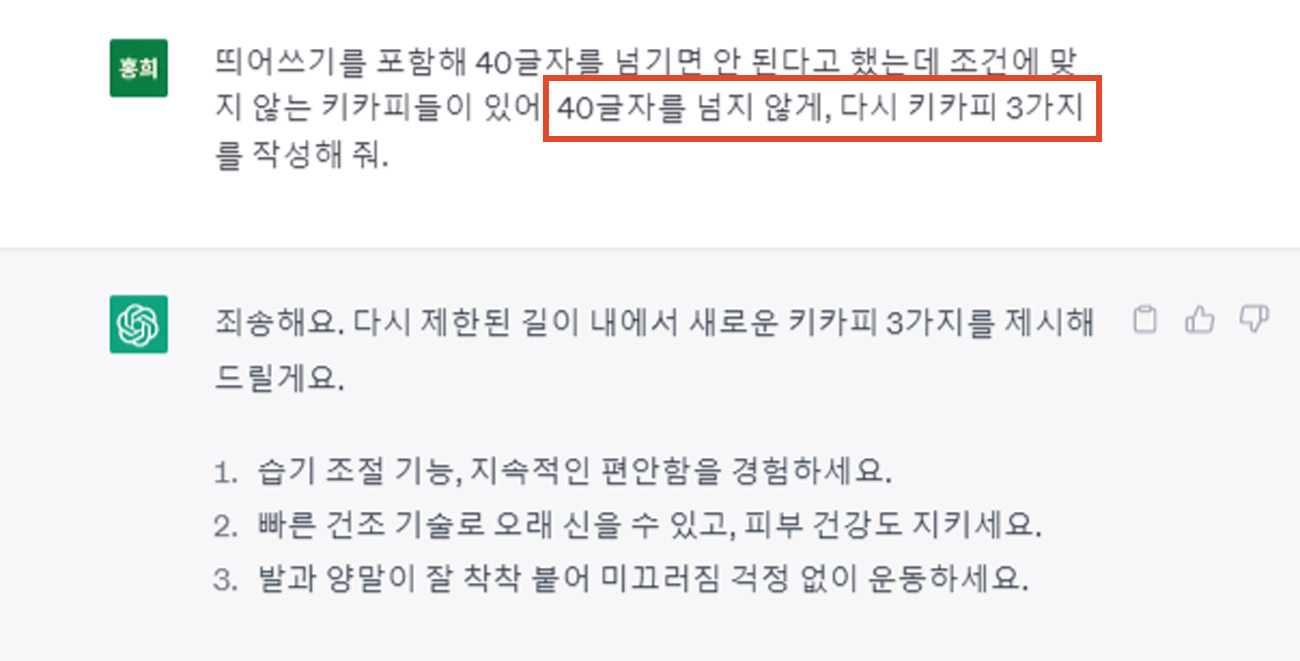
It’s also possible to keep the core message of the ad copy intact while simply changing the wording. For example, I asked ChatGPT to rewrite the copy it initially generated in a “funny and entertaining” way. Here’s the result. It was right here that I was able to come up with a new concept: “Inside the shoe is hell.”
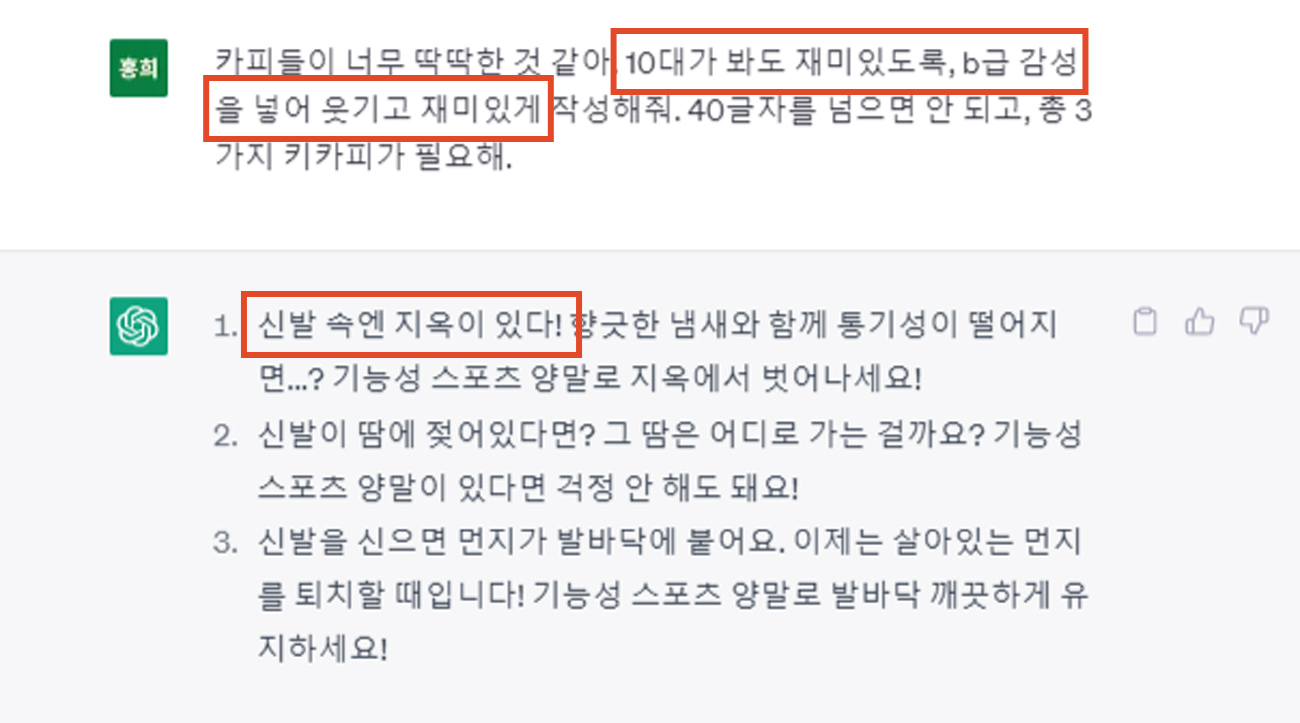
By combining human ideas with ChatGPT,
I completed the ad copy
After several rounds of conversation, I asked ChatGPT to write copy that incorporated the “inside a shoe is hell” concept, but I didn’t get a response I was particularly happy with. Since I couldn’t keep ChatGPT going indefinitely, I wrapped up the conversationand finished the copyby subtly adding the idea of “moisture and heat ”: Escape the “hell” inside your shoes! New-material functional socks that absorb moisture and heat—around 4,000 won
Here, “moisture and heat” is simply a more accessible way of describing “absorbency and breathability”—key product features ChatGPT had recommended. You might say that this is just me adding a spoonful to the meal ChatGPT prepared, but it was the human content director who set the parameters for ChatGPT, transformed the “hell” concept into more relatable and eye-catching copy, and found and designed images to match. As with everything, collaboration is ultimately what’s needed.

What pride should we set aside today?
?
If there’s a difference,
- The fact that I worked with ChatGPT on my own to come up with a concept, without needing meetings with other content directors,
- And because the time spent deriving the concept was drastically reduced to under 10 minutes, the content director’s total work time was significantly cut.
isn’t this the future of the content industry that ChatGPT and AI will bring?
Just as cameras—once the exclusive domain of professionals—are now built into everyone’s smartphones, allowing anyone to live with the potential to be a photographer, the content industry—once thought to be dominated by those who shine with innate creativity—is becoming a vast field where anyone can take root as a copywriter or content director.

We can never, under any circumstances, defeat an AI that has learned—and continues to learn—from trillions of data points,simply because we think our own experience is superior or because ChatGPT still feels awkward and falls short of human capabilities .It’s time to stop fightingand start collaborating quickly.
Now, it’s becoming even harder for those who firmly lock away “their own boundaries” to survive. This is a world where the more you cross those boundaries, approach unfamiliar fields with humility, and humble yourself to learn new knowledge, the more likely you are to survive. Just as it was in England over 200 years ago, this is a trend we cannot reverse or resist. So, what pride should you set aside today, and what new knowledge will you gain?
<Content Director’s Column> Series
- [Content Director Column #1] Why Product Detail Pages Need to Be “Detailed”
- [Content Director's Column #2] Product Detail Page Order: I'll Just Set It for You.
- [Content Director’s Column #3] Step-by-Step Guide to Launching a Product Detail Page
- [Content Director Column #4] There’s No Such Thing as a “Women in Their 20s” Target Audience.
- [Content Director Column #5] Why You Should Write the Product Detail Page Even Before You’ve Taken Product Photos
- [Content Director Column #6] How to Write a Product Page Summary in 3 Minutes
- [Content Director Column #7] 3 Ways to Boost Sales by Adding Just One More Line
- [Content Director Column #8] How to Instantly Improve Your Product Page Copy by Changing Just a Few Words
- [Content Director Column #9] How to Write Product Descriptions That Let You Charge Fair Prices Amid Price Wars
- [Content Director Column #10] How to Write Ad Copy in Just 10 Minutes Using ChatGPT
-
Text/Photos/Editing by Choi Hong-hee
This article is an excerpt from “How a Content Director Writes Ad Copy in 10 Minutes Using ChatGPT,”originally published on Fashion Post on May 29, 2023.
※ If you share or use content (text, images, videos, graphics, data, etc.) posted on the wadiz maker center externally, please be sure to cite the source.

|
||
|
|
|
|
|
|

|
||
|
|
||
Do you have more questions about wadiz advertising? Search the wadiz maker center or contact us about advertising.