[Funding Guidebook for Practitioners #4] How to Write the Second Half of a Product Detail Page to Drive Conversions
Planbro, an official wadiz partner,
will use the<FUNDING Guidebook for Practitioners>
shows you how to write the latter half of your Story
Be sure to take this with you!
- The latter part of your story is a crucial section that can drive purchase conversions.
- To drive conversions, you need to highlight the product’s strengths by focusing on the benefits customers will receive.
- Here are five ways to highlight your product’s strengths that will leave a lasting impression on customers right up to the very end.
You might be thinking, “Isn’t just the introduction important on a product detail page?”
A product detail page is a seamless “path” that leads all the way to conversion. Even if you’ve crafted the first two stages (ad creative or thumbnail, and the Story’s introduction) perfectly, the path will inevitably be broken if problems arise in the latter stages.To ensurethispath remains unbroken, you’ll need to wrap up the latter stages effectively.

The Goal of the Story’s Second Half
If, after reading the entire Story, the customer feels that the value they’ll gain from the product outweighs the price, a conversion will naturally follow. In other words, when highlighting the product’s strengths, you should focus on the benefits the customer will receive. Considering the product’s features comes next.
3 Steps to Writing the Second Half
Once you have a clear understanding of the goal, start writing the latter part. Trying to write it perfectly from the start is bound to give you a headache. It’s much easier to proceed step by step.
Step 01. Gathering Materials
First, list all the product’s strengths. However, since abstract expressions like “good” can be interpreted differently depending on the person, you need to be specific. Focus onphrasing it so that most people will have the same thought just by reading the text.
Example: Attractive design → Slim design that fits in the palm of your hand Example) Affordable price → One-third the average price of the top 1–10 products on Naver Shopping Example) Unique structure → Features a U-shaped structure not found in other cushions Example) High-quality ingredients → Hyaluronic acid, a “moisture bomb” (specify the ingredient’s name) |
Step 02. Think About the Value Customers Will Feel
Customers aren’t interested in the materials we’ve gathered. They care more about “what value those materials provide to me.” Let’s break this down a bit more specifically. Generally, when people buy a product, they perceive the following as “valuable.”
- Saving me money
- Saves you time
- Making me more attractive
- Helping me and my family stay healthy and secure our future
- Making my space a place I want to spend more time in
- Bringing me closer to the life I aspire to
- Things that improve my daily life in ways I hadn’t thought of
If we rephrase the materials listed in the example above in terms of value to the customer, we could do so as follows.
Example) Slim design that fits within a span → It fits perfectly even in a narrow kitchen space Example) One-third the average price of the top 1–10 products on Naver Shopping → Over 70,000 won cheaper Example) Features a U-shaped structure not found in other cushions → Helps prevent hip dislocation in babies Example) Moisture-Boosting Hyaluronic Acid (specify ingredient name) → Keeps your skin hydrated until morning when applied before bed |
Step 03. Organize Your Thoughts
Let’s structure the two points mentioned above. Simply group your various strengths around the concept of “value.” Start by highlighting the value the customer will experience, then explain the strengths you identified from your perspective in simple terms to support that value. If there are two or three strengths that support a specific value, you can present them together.
Example) Office humidifier Can be placed on a small desk (Value) Compact size (reason) + Clean white color (reason) |
After grouping them into at least three points that include both value and supporting evidence, refine the copy and visual elements (images, GIFs, tables, design, etc.) to complete the latter part.When creatingvisuals, try to do so with the intention of painting a picture in the customer’s mind. The more customers smile as they imagine themselves using our product, the higher our sales will rise.
5 Ways to Leave a Lasting Impression
To explain a product’s strengths, you’ll need the right phrasing. If you’ve established the structure but are unsure how to flesh it out, refer to these tips.
1) Comparison
 “Airia” Bathroom Heater Project / Source: wadiz
Showcase your product’s strengths through comparisons—such as your company’s existing product vs. the new product, generic products vs. your product, or before vs. after using the product . However, direct comparisons with specific brand products are not allowed.
2) Experiment
 "Airia" Bathroom Heater Project / Source: wadiz
Make the invisible visible.Factors such asairflowintensity, temperature, odor removal, and absorption capacity cannot be experienced on a smartphone or computer screen. It is best to design the content so that it has a strong visual impact when presented as a GIF.
3) Process
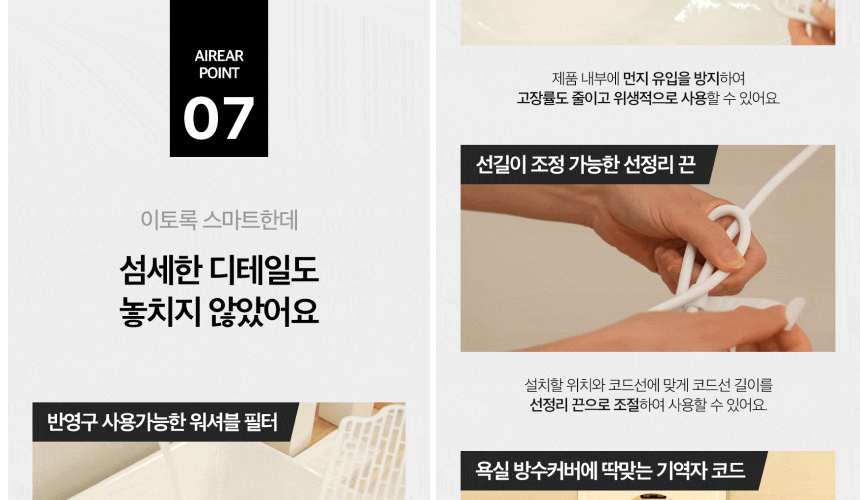 "Airia" Bathroom Heater Project / Source: wadiz
Explain the process through which the product’s strengths were realized. Showcase the efforts we’ve made—such as design sketches, manufacturing processes, and improved distribution channels—to build anticipation for the product.
4) Certifications
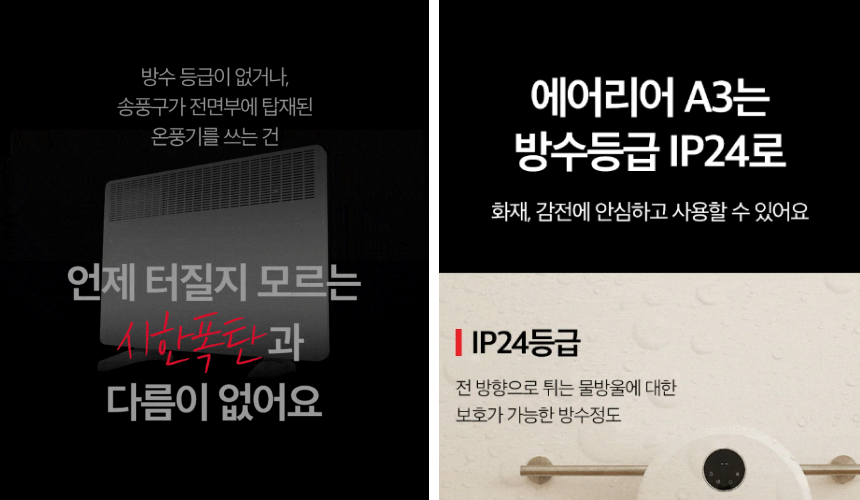 "Airia" Bathroom Heater Project / Source: wadiz
Certifications from experts and specialized institutions are key factors in building trust in the product. You can also incorporate various reviews and collaborations with influential figures (celebrities, YouTubers, influencers, etc.) or brands in specific fields.
5) Story
Share a story that reveals why you had to relentlessly focus on that particular strength.Stories—such as how you prioritized comfort to overcome personal challenges stemming from a body type differentfrom others—further increase customer engagement.
Final Review Stage
Once you’ve fleshed out the plan, show it to others for a final review. Ideally, share it with people outside your industry who most closely resemble your target audience, and ask them the following questions.
- Are there any words you don’t recognize? → I’ll replace them all with different words.
- Is there an explanation you don’t understand right away? → Find a way to explain it more simply.
- Is there something you’d like to know more about? → Add it to the FAQ or include it in the Story.
- Is there a part that’s hard to believe? → I’ll gather more evidence.
- Can you tell me the most memorable part without looking at the content? → I’ll try to incorporate it into the intro or ad copy.
After refining the plan several times and completing the filming and design that align with it, a great Story is complete.Since you’vepainstakinglypaved this path, you’ll want to ensure that many people visit it. I’ll be back soon to discuss marketing strategies.
Makers, check out the services you need!
- Learn how to start a wadiz project
- Check out the [Maker Events] currently open for registration
- Watch [wadiz funding lectures] led by funding experts
- Start your project with a [wadiz Official Expert]
 Written byJeon Su-yeon,Planbro Editor