[Content Director’s Column #1] Why Product Detail Pages Need to Be “Detailed”
This content is
<Content Director’s Column>
series.
Be sure to take this with you!
- If you’ve always believed that short and concise product detail pages are the way to go, I’m here to challenge that notion.
- I’ll explain why brands that are just getting started actually need a “messy product detail page.”
- Check out the last paragraph to learn the easiest way to study product detail pages.
“It’s really great for guys, but I just don’t know how to put it into words. It’s kind of awkward to say it directly.”
Even if you’ve never heard of Cheonho Foods, some of you probably had a commercial play in your head the moment you read that line. The fact that a commercial from 2010 is still so vivid in my memory shows that it was definitely well-made. It piqued the curiosity of its target audience and left a lasting impression.
Taking inspiration from this ad’s concept, I’ll try my hand at creating one myself. It’s not about cornelian cherry—it’s about shoes. Since it’s 2021, not 2010, I’ll write a product description page for our company’s online store or an online fashion platform rather than a TV commercial. If I reveal only the bare minimum of information to spark curiosity… wouldn’t it feel something like this?
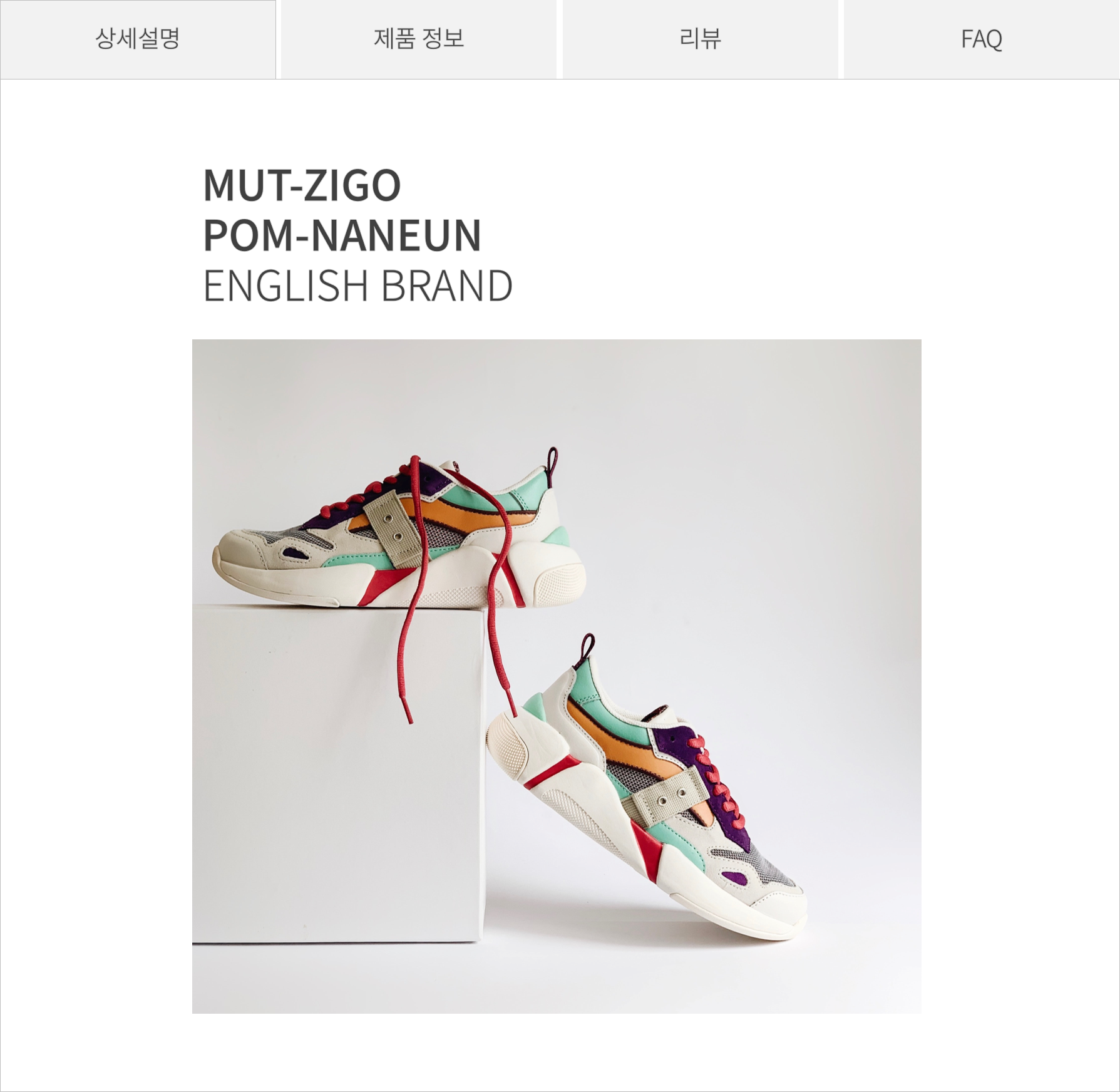
A single, stylish line of English text and one product photo. I’d show only the product photo—without any details about the outsole, the cushioning of the insole, the materials used, or care instructions .
And I would have failed.
This is a completely different outcome from Cheonho Foods’ massive success with a single ad—and it’s an ending no one would have wanted. The reason is simple: it’s not 2010 anymore, and what we need to focus on isn’t TV commercials but online product detail pages.
I just wanted to spark curiosity, but I failed?
It’s because customers aren’t curious about my shoes. If you search for “shoes” on Naver Shopping, you’ll get 64,711,177 results. (As of January 15, 2021)
Even if only 1% of sellers have carefully crafted their product pages, customers can still learn more about 647,111 pairs of shoes—from the outsole manufacturer to the cushioning of the insole—than they would by trying them on in a store. So, customers who want the best possible shopping experience within a limited budget have no reason to buy shoes they don’t know much about. That’s a gamble.
The newer the brand,
the more “detailed” their product pages must be.
Working as a content director on a crowdfunding platform, I see “Stories” written in far greater detail than typical online product pages on a daily basis.
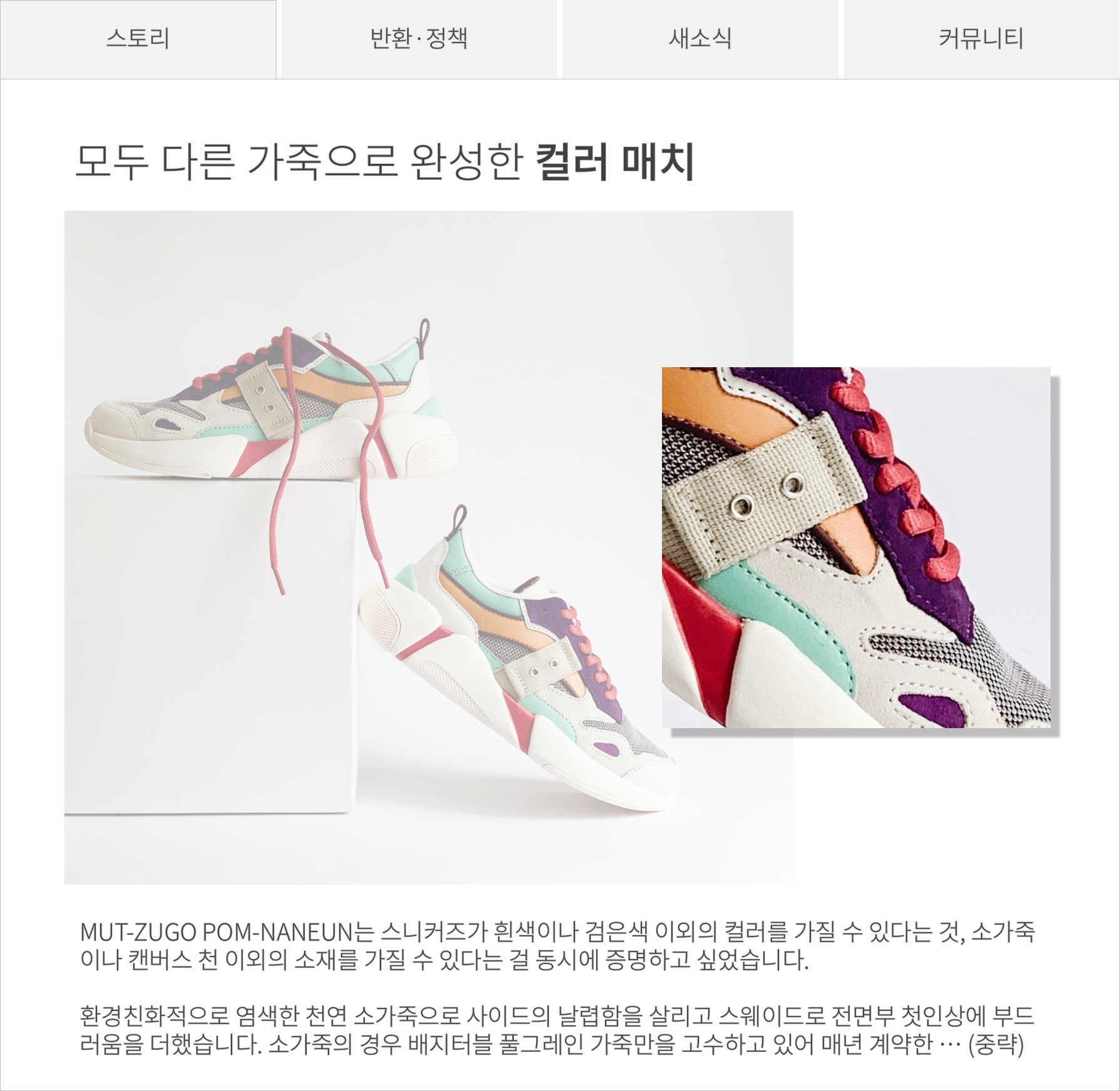
If this were a brand’s own online store, a sentence that might simply say, “Each pair uses a different type of leather to create a vibrant color combination,”
- Starting with why I wanted to showcase a vibrant color scheme,
- to where the leather comes from
- and who crafts it,
and breaking it down point by point is a hallmark of wadiz Stories. It goes something like this.
Why do they do this?
It’s because most of these are brands that have just launched.
First,
Since many new brands launch funding campaigns to generate sales without inventory, for promotional purposes, or for market research, supporters (customers) often hesitate—even if they like the product—fearing it might be a gamble because they’re being fooled by flattering photos or models.
Second,
Above all, just because funding launches today doesn’t mean the product will arrive tomorrow. In South Korea, where “order today, arrive tomorrow” is the norm, there’s no reason to back funding unless there’s a compelling reason to wait “despite that.”
In other words, the newer the brand,
compared to well-established brands,
they must thoroughly explain to customers what makes their products great and why—otherwise, they won’t generate sales.
Customers already have specific brands that come to mind when they think of “shoes.”
- you’ll have plenty of firsthand experience with the brand, as well as plenty of feedback from people around you—like when you ask, “What do you think of the 000 model?”
- Even if they aren’t reviews from people you know, the brand’s product detail page is full of reviews from strangers.
Everything about them conveys the message: “If you buy shoes from this brand, you can’t go wrong.”
But a new brand has none of these advantages.
Since production has just begun, there are very few customers who have purchased from your brand; even fewer who will write reviews; and even fewer still who will recommend it to others. Since new brands don’t have any customers who are curious about their products and willing to wait for them, they need a product detail page that logically and systematically explains “why customers should choose them over familiar brands”—even if it’s just to secure those initial customers.There’s so much to show, from the fabricto the accessories ,and it’s nearly impossible to capture it all in a single photo.
When the product they receive matches the product description page created in this way, only then will customers conclude, “I can take a chance on this brand!”
As the success rate of that “bet” increases, customers begin to experience the values your brand prioritizes—such as “This brand really knows its fabrics” or “No one else can match the comfort of these shoes.” As the number of such customers grows, the need to write overly detailed product pages diminishes. By then, your brand will already have a reputation for its fabrics or comfort, so there’s no longer a need to explain it. Finally, we’ve become a brand that can spark customers’ curiosity with just a single photo.
But to get there, we first have to make sales.
Even though I’m the head of the content team at wadiz,
I, too, sometimes get a “reality check” when writing product descriptions.
I find myself thinking, “Do I really have to write about this too?” It feels like a waste of time, and it just seems needlessly tedious. But if we refuse to go through this process, we might end up with an outcome no one wants. For example, going out of business.

It would be nice if reality ended this cutely,
but we know all too well that it doesn’t.
So, start by checking out well-known online stores that sell similar products.
- From how much space is devoted to each point
- to the angles and close-up shots used in the detailed photos,
It’s a good idea to take a thorough look.
Never just copy them exactly—simply thinking about how you’d write and photograph your own product will provide valuable insights for your next product launch. If you keep telling yourself, “One day, I’ll beat them,” you’ll gain a burning determination.
Reading articles on how to write product detail pages is also helpful. Just search for “product detail page” on Maker Center, and you’ll find a wealth of tips written by industry professionals in various fields. If even that seems like too much trouble, be sure to check out the monthly product detail page column written by wadiz’s Content Director and Head of the Content Team.
That’s right—this column series is exactly that. Just by reading the series below, you’ll be able to plan and write product description pages that sell one more item than the competition.
<Content Director’s Column> Series
- [Content Director’s Column #1] Why Product Detail Pages Need to Be “Detailed”
- [Content Director’s Column #2] The Order of a Product Detail Page: Let Me Just Set It for You.
- [Content Director’s Column #3] Step-by-Step Guide to Launching a Product Detail Page
- [Content Director’s Column #4] There’s No Such Thing as a “Women in Their 20s” Target Audience.
- [Content Director’s Column #5] Why You Should Write the Product Detail Page Even Before You’ve Taken Product Photos
- [Content Director Column #6] How to Write a Product Page Summary in 3 Minutes
- [Content Director Column #7] 3 Ways to Boost Sales by Adding Just One More Line
- [Content Director Column #8] How to Instantly Improve Your Product Page Copy by Changing Just a Few Words
- [Content Director Column #9] How to Write Product Descriptions That Let You Charge Fair Prices Amid Price Wars
- [Content Director Column #10] How to Write Ad Copy in 10 Minutes Using ChatGPT
Makers, check out the services you need!
- Learn How to Start a Wadiz Project
- Check Out [Maker Events] Open for Registration Now
- Sign Up for [wadiz Funding Courses] Taught by Funding Experts
-
Text/Photos/Editing: Choi Hong-hee
This article is an excerpt from “It May Be Clunky, but the Product Page Is ‘Detailed’,”originally published on Fashion Post on January 25, 2021.
※ If you share or use any content (text, images, videos, graphics, data, etc.) posted on the wadiz maker center externally, please be sure to credit the source.