[Content Director’s Column #4] There is no such target audience as “women in their 20s.”
This content is part of
Episode 4 of the <Content Director’s Column>
series.
Be sure to take this with you!
- If you can only describe your target audience as “women in their 20s” or “busy modern people,” you must read this.
- I’ll help you gain a clear understanding of what “target audience analysis”—which you may have only vaguely guessed at—actually entails.
- You’ll learn why starting with target analysis when preparing a product detail page is key to staying ahead of the competition.

Why There’s No Such Thing as a “Woman in Her 20s” as a Target Audience
Let me give you a concrete example.
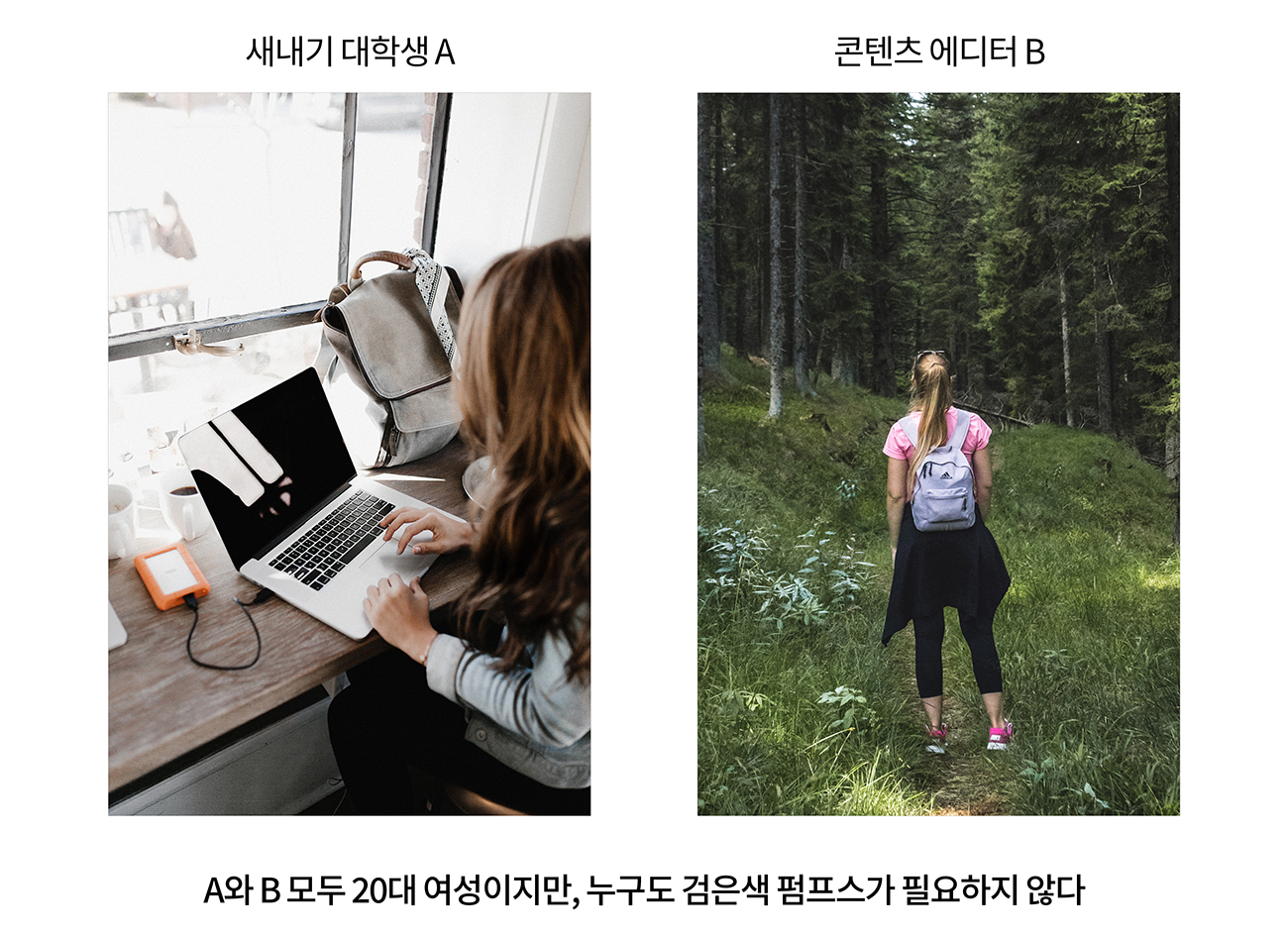
Let’s assume you need to sell simple black pumps with no embellishments to women in their 20s. Here are two women in their 20s, A and B.
A is a freshman
her first year of college.
On Mondays, Wednesdays, and Fridays, she works part-time at a chain café near campus, and on Saturdays, she attends her presentation club. Since many clubs have shifted to online activities following the COVID-19 pandemic, most of A’s club activities also take place online.
B is a content editor who recently celebrated her third anniversary
content editor who recently celebrated her third anniversary at the company.
To celebrate the milestone, the company granted B a two-week vacation. Since B has always enjoyed exercise and travel, they plan to hike the Jirisan Mountain Trail during their time off. Not being a professional hiker, B intends to schedule rest days along the way and combine the hike with a tour of charming cafes offering great views of Jirisan.
Based on the description alone, we can guess that A is twenty years old,
and B is about twenty-seven.
Since they’re both women in their 20s, you might think they could easily afford our pumps, but in reality, neither A nor B will buy them.That’s because black pumps aren’t a necessity for the lifestyles of A and B, who are both in their 20s.
Let’s look at A.
A is a freshman in college, but since many universities have become accustomed to online, remote classes, we can assume she won’t spend as much on clothes, shoes, or accessoriesas freshmen did before the COVID-19 pandemic. If she absolutely has to buy something new, she’ll likely be more interested in comfortable sneakers than pumps, since she works part-time at a café.
Since she’s part of a club that requires formal “presentations,” she might have hesitated for about three seconds right after being accepted, wondering whether to buy a pair of neat black pumps. However, once she learned that the presentations would be held online, she most likely dismissed the idea immediately. After all, no one will be able to see what shoes she’s wearing during an online presentation. It would actually be more helpful for A to search for and buy a white blouse instead.
Let’s look at B.
Since B is about to take a long vacation and has a lot to prepare for, she’ll likely be more eager to buy new items than A. However, unlike A—who hesitated for about three seconds over buying black pumps—B probably won’t be interested in our shoes at all. First of all, since B is planning a vacation that includes hiking the Jirisan Mountain Trail, she’ll likely be most interested in hiking boots or trekking shoes. She might buy a separate pair of shoes to take “Instagram-worthy” photos at the cute cafes she’ll visit, but considering the theme of her vacation, she’s more likely to choose everyday sneakers rather than pumps.
So, would B have bought pumps before leaving for vacation? B loves exercise and travel. While B would have spent generously on functional athletic shoes that boost workout efficiency and reduce travel fatigue, it’s reasonable to assume that pumps would be a low priority.
Based on demographic customer analysis,
this is an era where you can’t sell anything.
Let’s start by looking at
“demography”?
Demography is the study of a defined population group, examining characteristics such as gender, age, marital status, religion, language, race, occupation, social class, and educational level. (Source: Naver Doosan Encyclopedia) The group “women in their 20s” can be viewed as a demographic segment defined by gender and age.
In the past, when lifestyles weren’t as diverse as they are today, demographic customer analysis was quite effective. There was a time when it was considered natural for women in their 20s to wear black suits to job interviews and to wear black pumps with moderate heels when going to work or attending important events.
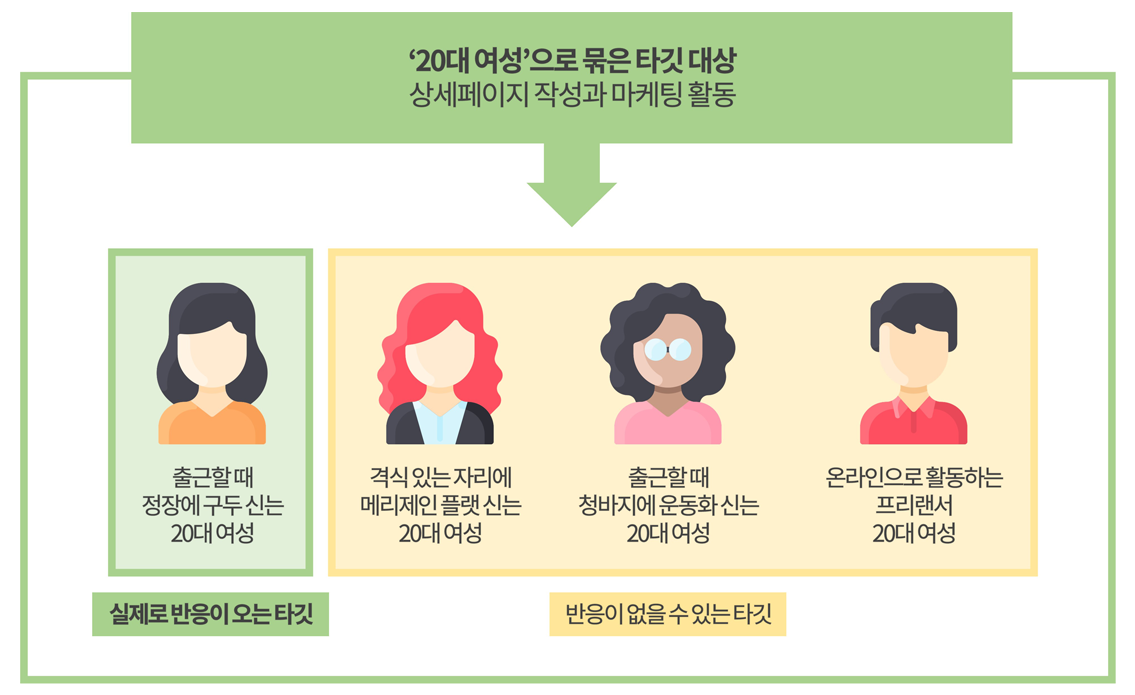
However, in modern society, customers’ lifestyles are becoming increasingly segmented, and it is growing more difficult to find common ground between these lifestyles and demographic characteristics. This means that when asking 300 women if they “intend to purchase black pumps,” it is becoming harder to categorize those who answered “yes” by a specific age or occupation.
In other words, the probability is increasing that women in their 20s—the very group we expected to answer “yes” without hesitation, namely our Groups A and B—will instead say they have “no intention of purchasing pumps.” From our perspective, having worked hard to market and advertise specifically to women in their 20s, this means we’re throwing more and more money down the drain.
Of course, there are certainly still women in their 20s for whom black pumps are a natural
.
However, just as many women are now wearing jeans and sneakers to work instead of dress shoes with a suit. More people feel comfortable wearing Mary Jane flats instead of pumps to formal occasions, and there are now many freelancers who work primarily online without ever going into an office. If we lump all these people together under the broad category of “women in their 20s,” we’ll see only minimal returns on our investment.
What about the hobby of “sneaker travel”?
It’s not just women in their 20s—our customers’ hobbies are becoming incredibly diverse. Exercise has also become highly specialized, ranging from Pilates, yoga, and CrossFit to running, trekking, hiking, and skating, and customers demonstrate a level of interest, knowledge, and passion for their hobbies that rivals that of experts.
Our increasingly specialized and niche-oriented customersare no longerlooking for “comfortable shoes for hiking,” but rather“waterproof hiking boots specifically designed to keeptheir feetdry and prevent slipping even during long-distance hikes on snow-covered trails in winter.” No matter how much we try to market our products to these customers as “comfortable hiking boots,” it will become even harder for them to choose us.
To survive, we must now analyze what our customers find inconvenient and what products they want, breaking it down to the finest possible detail.
Don’t just analyze your target audience—
imagine.
Since not everyone is a data expert,
sometimes we need imagination.
I
- Break down your customers by lifestyle,
(Are they office workers who commute in dress shoes? Or freelancers who handle everything from home?) - and breaking down the specific problems customers face—
(not just hiking, but a long winter hike through deep snow where my shoes keep getting soaked)
call this “target visualization.” It involves assuming that a certain type of person is in a certain situation and starting to create content tailored to that scenario.
Visualizing the target audience
has surprisingly many advantages.
First, it allows you to create product detail pages that easily resonate with your target customers.
While everyone else is promoting their black pumps as “daily pumps for commuting,” you can describe in greater detail the situations where “daily pumps for commuting” were actually uncomfortable.
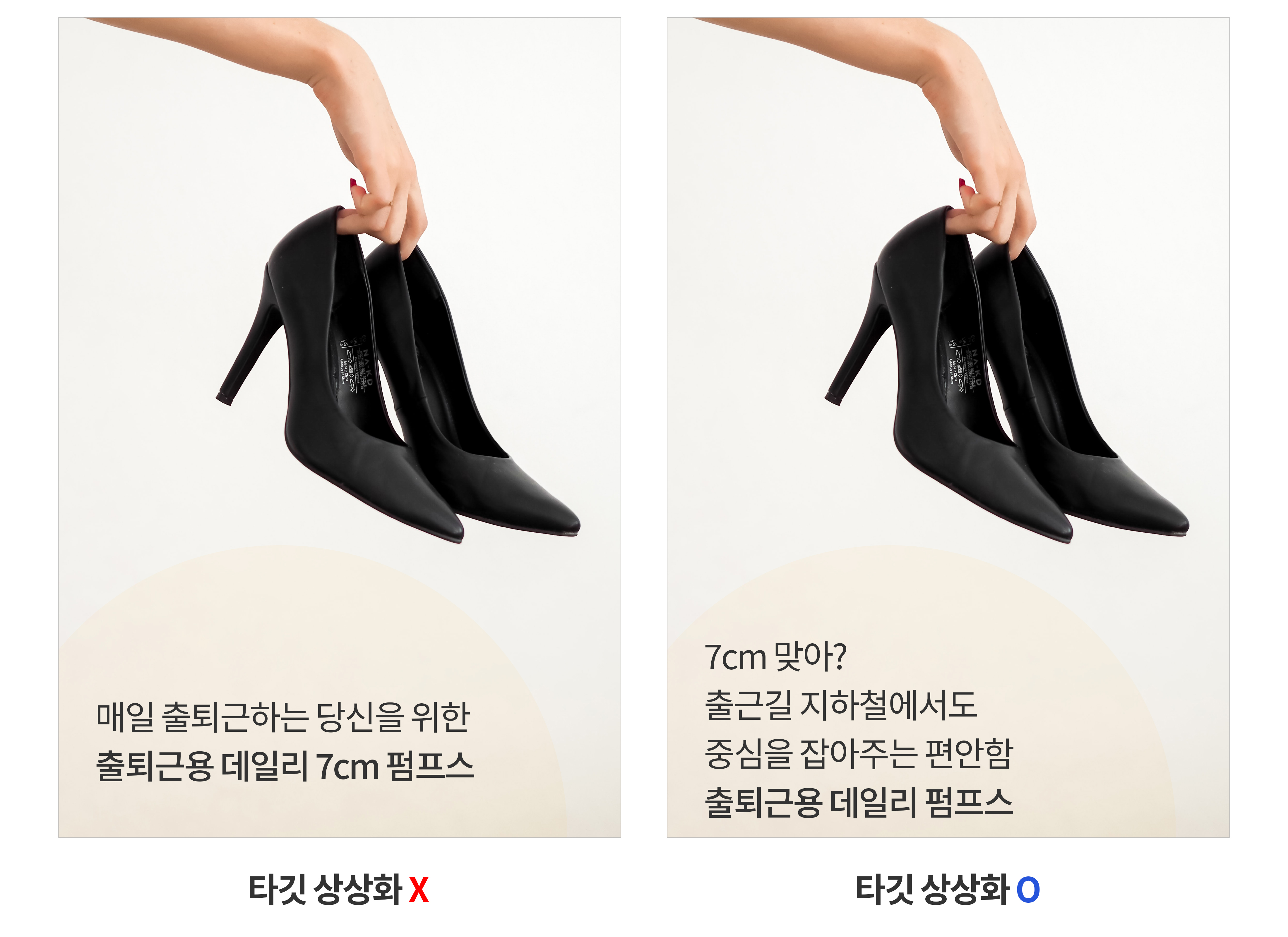
Because you can describe these situations in detail, you can explain the benefits and features of your product more thoroughly.
Instead of simply saying, “A 7cm heel that’s comfortable,” you can highlight the benefits in a way that resonates more deeply with customers, such as, “A 7cm heel that stays comfortable even after standing crammed on the subway for 45 minutes or walking up the stairs to an office on the third floor.”
Next, if you show the test results conducted to prove the stability of the 7cm heel and then explain the insole structure that enhances comfort step by step, you can organize the features of our pumps under the theme of “comfort.” Naturally, customer understanding will increase compared to explaining the heel and insole separately.
Second, you can secure a leading position in the market.
This is something smaller brands, in particular, should pay close attention to. The market is already flooded with “comfortable hiking boots.” Unfortunately, many of these products come from brands with more financial resources and a solid fan base than ours. Butwhat if we targeted the “comfortable hiking boots” market with waterproof hiking boots designed for winter hikes?
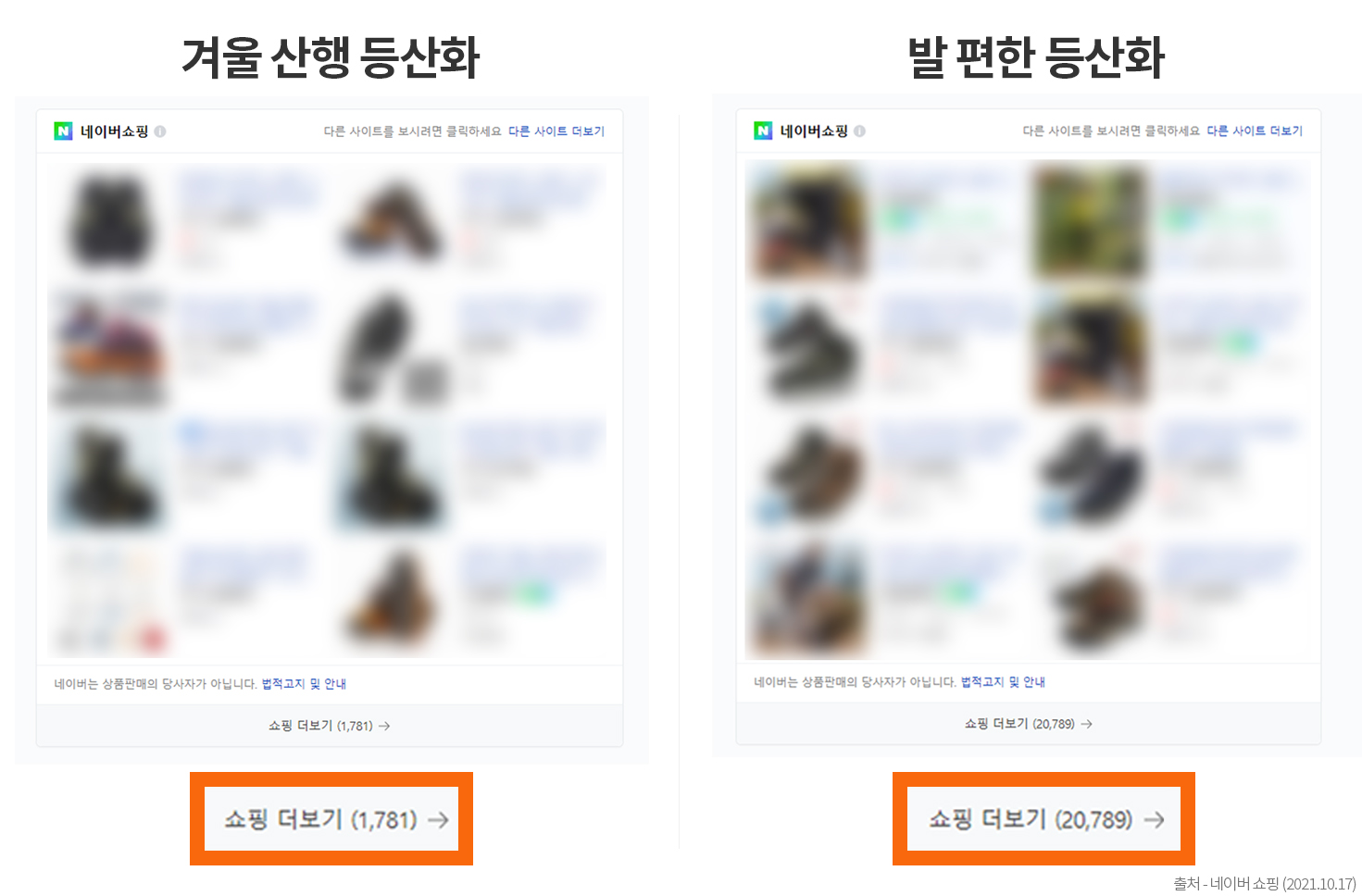
There are about 1,700 search results for “winter hiking boots” on Naver Shopping(as of October 17, 2021). This is significantly fewer than the roughly 20,000 search results for “comfortablehiking boots.”
If we aren’t confident we can rank first among those 20,000-plus results, we can start by aiming to be number one among the roughly 1,700. At the very least, if customers considering winter hikes think of our product as their top choice and become fans, we’ll gain the momentum to gradually expand into the “comfortable hiking boots” market.
For delicate embroidery,
a needle is better suited than an axe.
The more precisely we define our target audience, the clearer the market becomes that only we can appeal to. The likelihood that customers—whose“exact pain point”we’veprecisely addressed with our product—will become fans also increases. If all you have in your hand is a needle, there’s no need to waste time chopping wood in a futile attempt to compete with an axe and wear yourself out; instead, simply become the sharpest needle among them and create the most beautiful embroidery.
Of course, even if you think, “Oh, come on—is it really worth going to all that trouble just to sell a pair of shoes?” and choose not to segment your target audience, you can still lead the market. That is, if you’re not anxious about astronomical advertising costs and inefficient ad spending. Personally,since I lack both the nerve and, above all, the money to do that, I’m studying product detail pages diligently once again today.
<Content Director’s Column> Series
- [Content Director’s Column #1] Why Product Detail Pages Must Be “Detailed”
- [Content Director’s Column #2] The Order of Product Detail Pages: Let Me Just Set It for You.
- [Content Director Column #3] Step-by-Step Guide to Launching a Product Detail Page
- [Content Director’s Column #4] There’s No Such Target Audience as “Women in Their 20s.”
- [Content Director’s Column #5] Why You Should Write the Product Detail Page Even Before You’ve Taken Product Photos
- [Content Director Column #6] How to Write a Product Page Summary in 3 Minutes
- [Content Director Column #7] 3 Ways to Boost Sales by Adding Just One More Line
- [Content Director Column #8] How to Instantly Improve Your Product Description by Changing Just a Few Words
- [Content Director's Column #9] How to Write Product Descriptions That Help You Charge the Right Price Instead of Competing on Lowest Price
- [Content Director’s Column #10] How to Write Ad Copy in Just 10 Minutes Using ChatGPT
-
Text/Photos/Editing: Choi Hong-hee
This article is an excerpt from “‘Women in Their 20s’ Cannot Be a Target Audience,”originally published on Fashion Post on October 25, 2021.
※ If you share or use any content (text, images, videos, graphics, data, etc.) posted on the wadiz maker center externally, please be sure to credit the source.