[Content Director’s Column #5] Why You Should Write the Product Detail Page Even Before You’ve Taken Product Photos
This content is
Episode 5 of the <Content Director’s Column>
series.
Be sure to bring this!
- If you’re in a hurry and want to start with product photography, stop right there.
- Here are three reasons why writing your product description page before taking photos will ultimately lead to better results.
- This will help you avoid rushing and ensure you prepare only the photos and videos you actually need.
Just because you have a photo
to create a product detail page.
You can easily create a product detail page even without photos. Here’s an example.
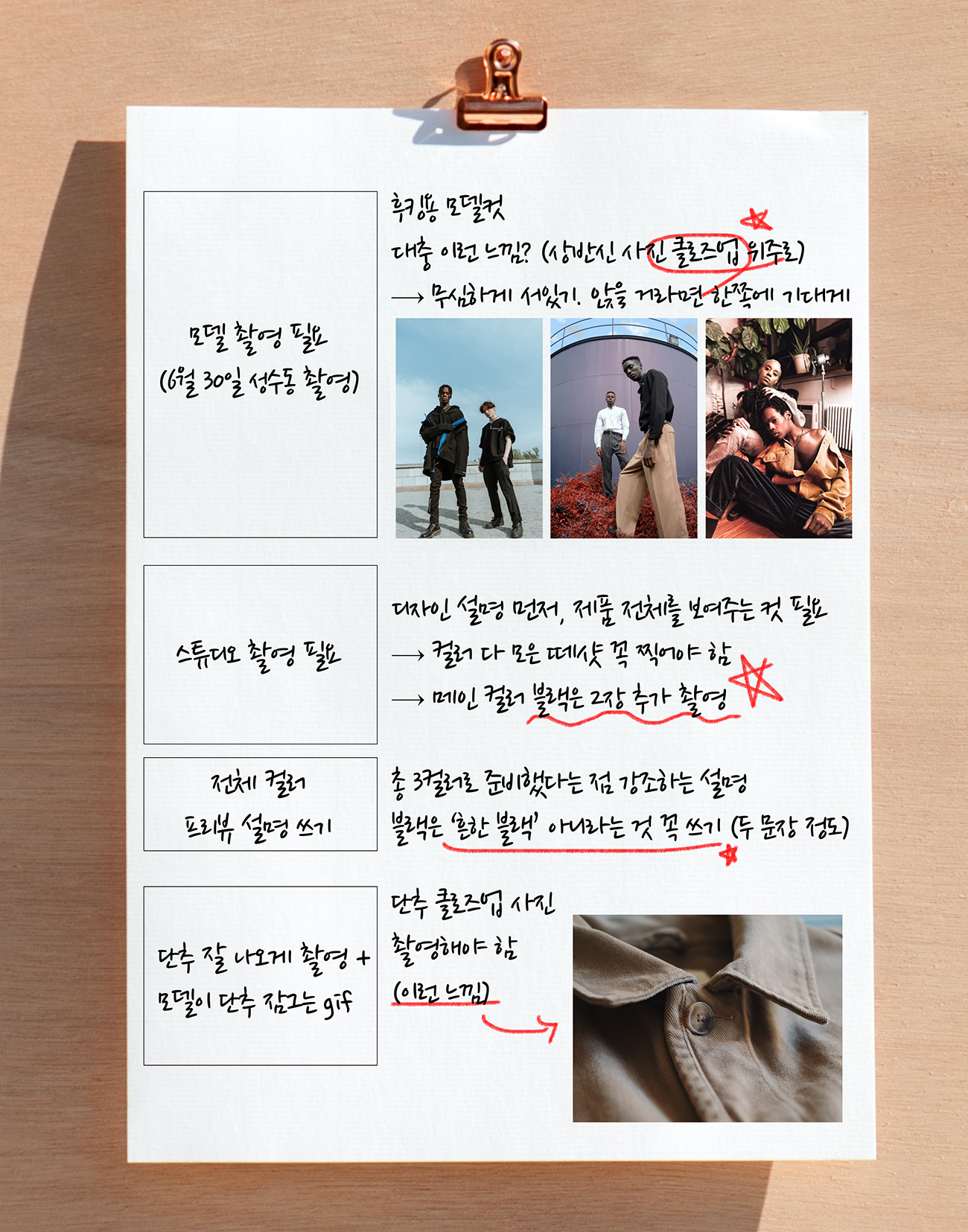
Although this is just a rough outline for the product detail page, you can get a general idea of the style of photos that will be included and the content of the descriptions. Now, if you take the necessary photos by the deadline and write the descriptions, the product detail page will be complete.
Photos are absolutely essential for product detail pages.
However…
Many people tend to book a product photography studio as soon as a new product launch is decided . Since photos are an element that “completes” the product detail page—not something absolutely required to create it—Iactuallyrecommend finishing the page to a certain extent first and then proceeding with the product photoshoot to “fill in” the details. This approach offers three key advantages .
- First, you’ll be able to shoot only the product photos and GIFs that are absolutely necessary,
- Second, you’ll be able to prepare representative images tailored to different platform environments,
- third, you’ll be able to complete the product detail page you want with minimal time and money.
First, the essential
product detail shots and GIFs.
How many times have you thought, “I should take these photos…”
over the years?
It seems like I’ve thoroughly researched references before the shoot, but the moment I arrive on set, I can’t remember a single thing—it’s a mystery every time. I suspect it’s because there are so many details to keep in mind and so much to prepare for when photographing products.
The more often you find yourself without usable photos for your product detail page despite the time and effort spent on the shoot, the more important it becomes to draft the product detail page before the shoot. This allows you to pinpoint exactly which shots are essential and whether they should be captured as still photos or as video footage for GIFs.
Let’s take a biker jacket photoshoot as an example.
If you head out to shoot without drafting the product page first, you’ll likely be able to take plenty of stylish model shots. The problem arises when you return and try to write the product page, only to find that you lack suitable photos to highlight the product’s key selling point: the quality of the leather.
In this case, you could crop the parts of the photos where the leather is visible and use those, but the quality won’t match that of photos taken from the start specifically to showcase the fabric’s surface. Even if you’re describing the same leather, you won’t be able to capture the same vibe as in the example on the right—a photo taken from the outset specifically to describe the bag’s leather on the product detail page.
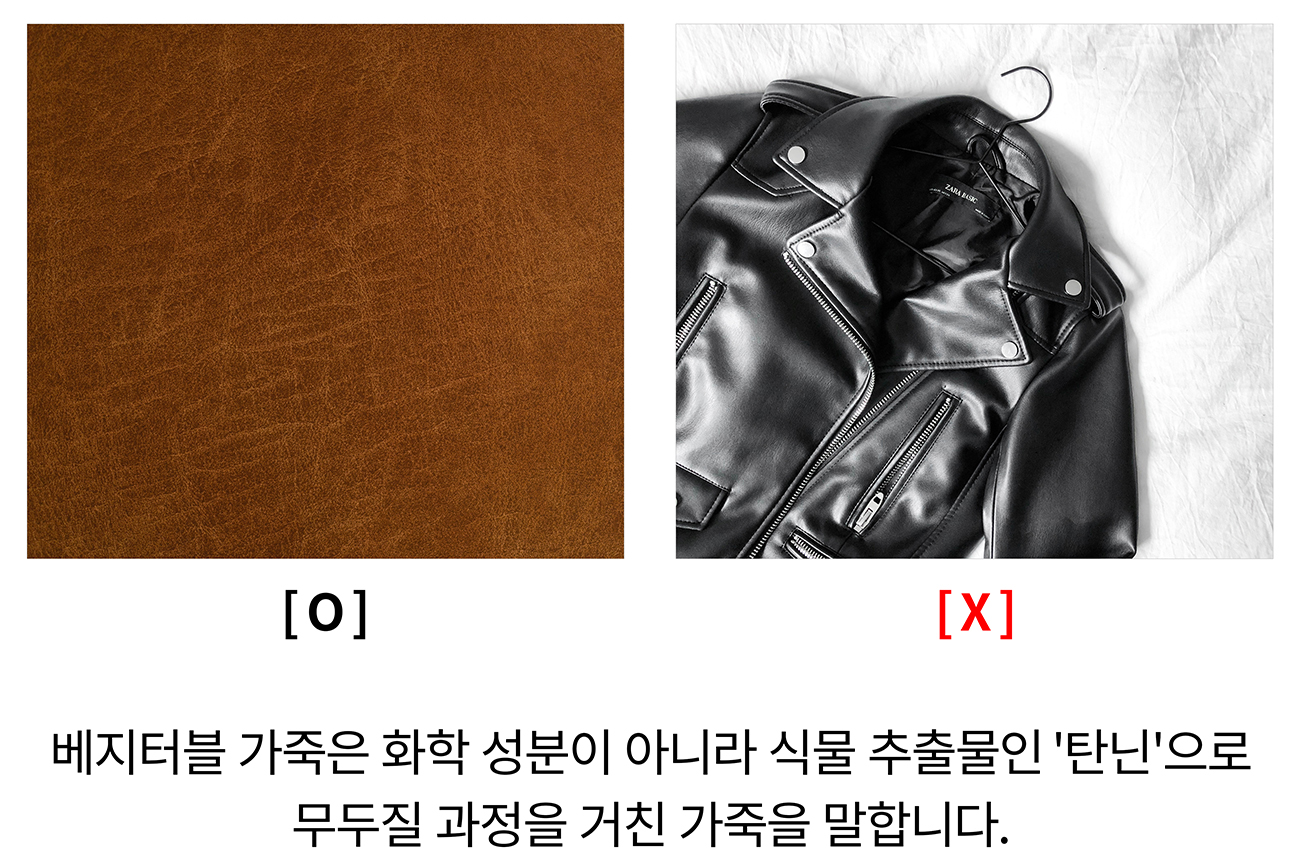
This is a classic example of a situation where
.
Even if you try to quickly snap a photo with your smartphone, the lighting and background will differ from those used in a product photography studio, resulting in a lack of consistency in the photos. That’s why you should plan the product detail page first before proceeding with the photo shoot.
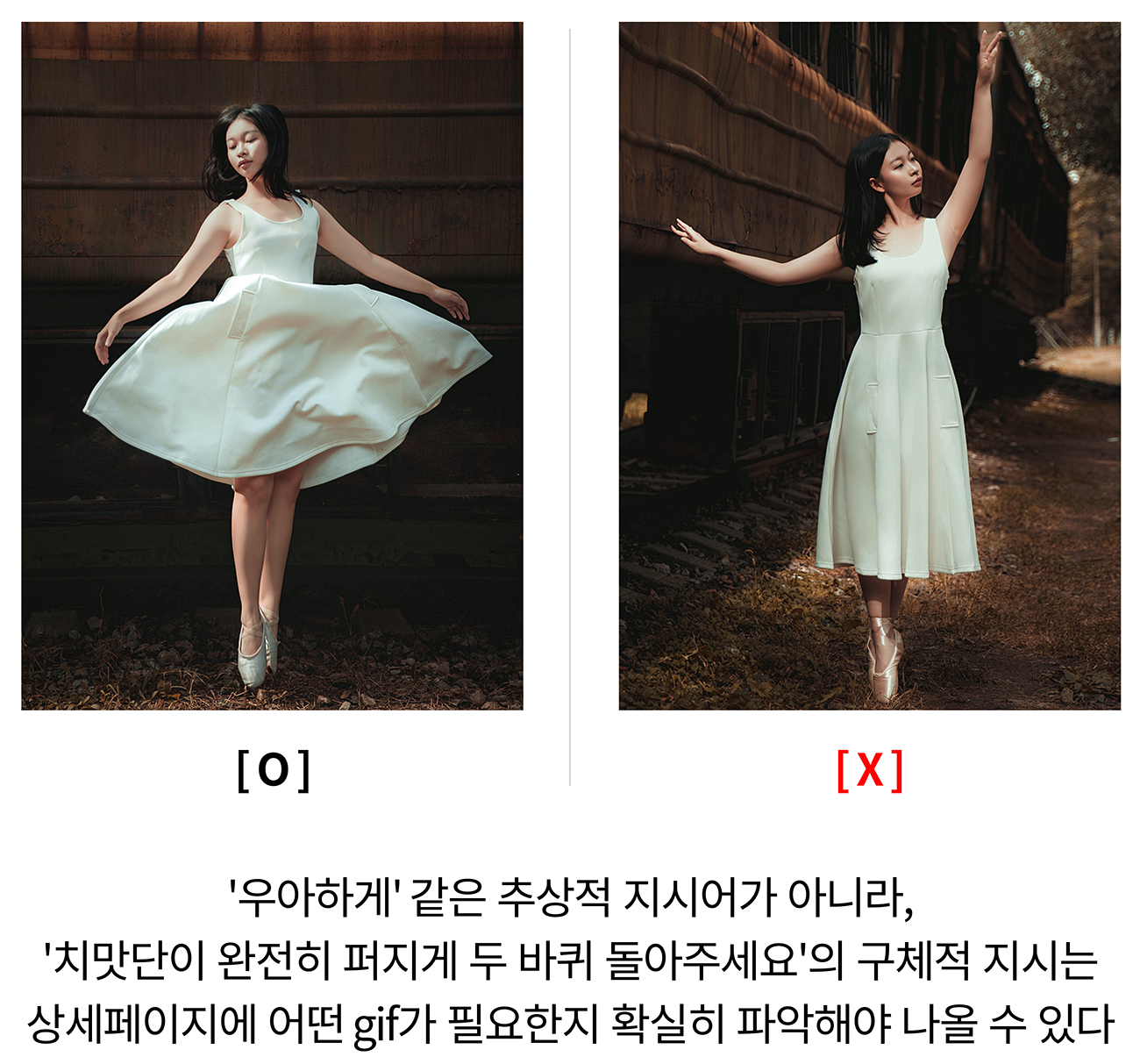
Another reason to draft the product detail page before shooting is so you can capture footage precisely for GIFs. GIFs—commonlycalled “animated images”—function like short video clips that loop repeatedly. It’s best to first draft the exact scenes you want to showcase on the product detail page, then go to the studio and shoot only those specific parts repeatedly.Let’s look atsome examples.
1. When you need to show dynamic movement, such as with a skirt or dress.
- Depending on the type of explanation needed on the product detail page, you might only need a GIF showing the movement of the skirt’s hem, or you might need to capture the model’s full body.
- Therefore, you can decide on-site whether to ask the model to “spin around so the skirt flares out nicely” or to “walk from the left to the right of the studio with a seductive expression.” Reducing unnecessary communication with the model is an added bonus.
2. When you need to showcase the flow and drape of fabrics like chiffon or modal.
- Whether you want to capture the fabric shimmering in the light or fluttering in the breeze will determine what time of day you shoot and what kind of footage you capture. For example, if you need light, you can focus on close-up shots of the fabric in the afternoon.
- If you need to capture the fabric fluttering in the wind, you can naturally decide on props—such as, “Oh, I’ll need to bring a fan when I go to the shoot.” Of course, you could open a window on set to create a breeze, but having a fan will definitely make the shoot easier.
Second, you can shoot photos
to fit the aspect ratio.
The representative image is the first image that appears
.
It serves as a direct tool to entice customers to click on our product among countless competing products, acting as an invitation that draws customers to the product detail page.
Since customers will only visit the product detail page if the main image is appealing, planners, designers, and sometimes even photographers gather in a studio to compare dozens or even hundreds of photos and select “the one.” Usually, the photo that showcases the product best is the winner.
The problem, however, is that just because a photo looks best doesn’t mean it’s suitable as the main image. This is because the standard size for the main image varies depending on the platform where the product page is listed. Forexample, the standard sizes for the main image differ between the crowdfunding platform wadiz and Naver Smart Store.
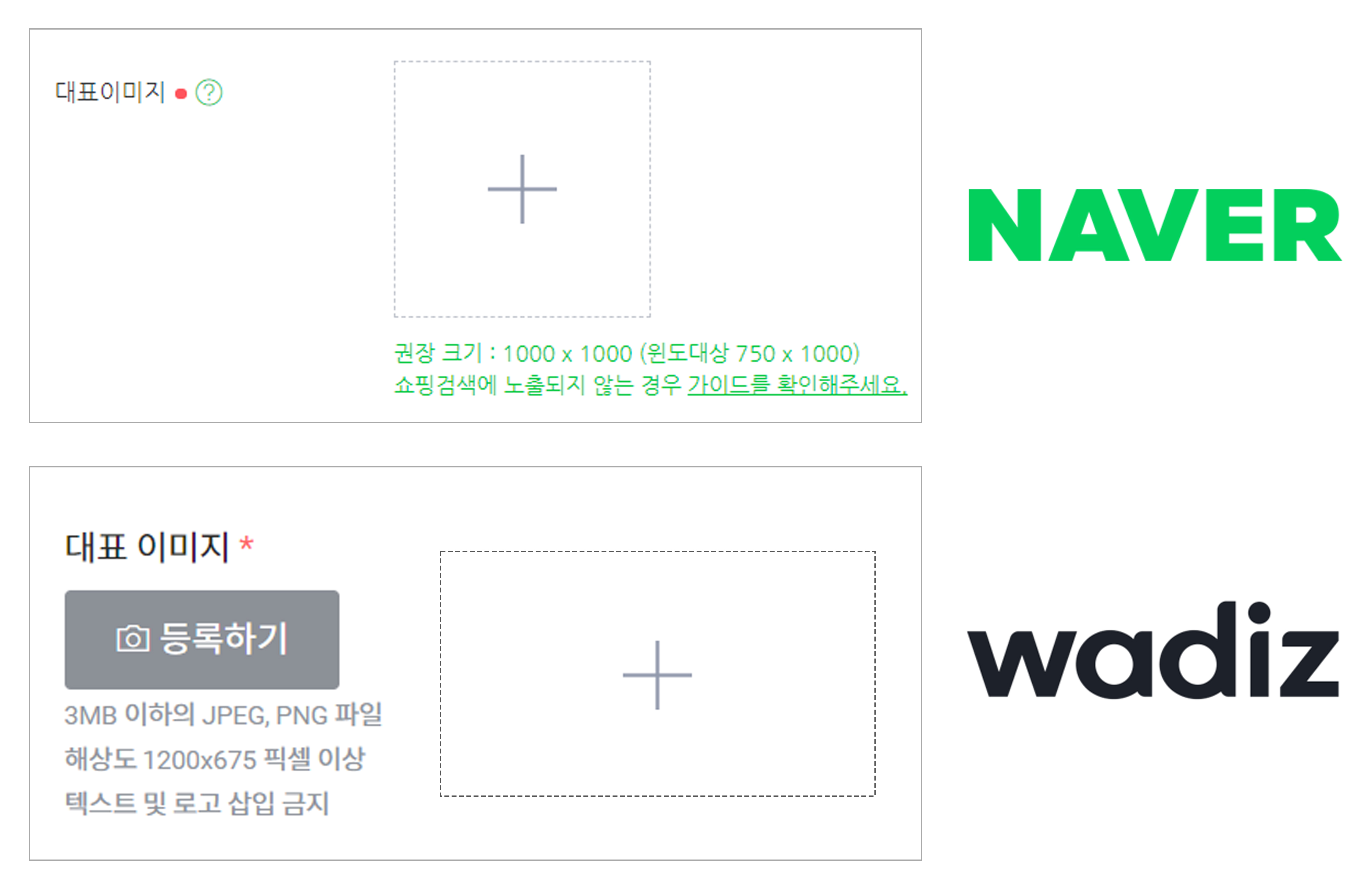
Therefore, even if it’s the same photo, depending on the platform,
it may or may not be suitable as the featured image.
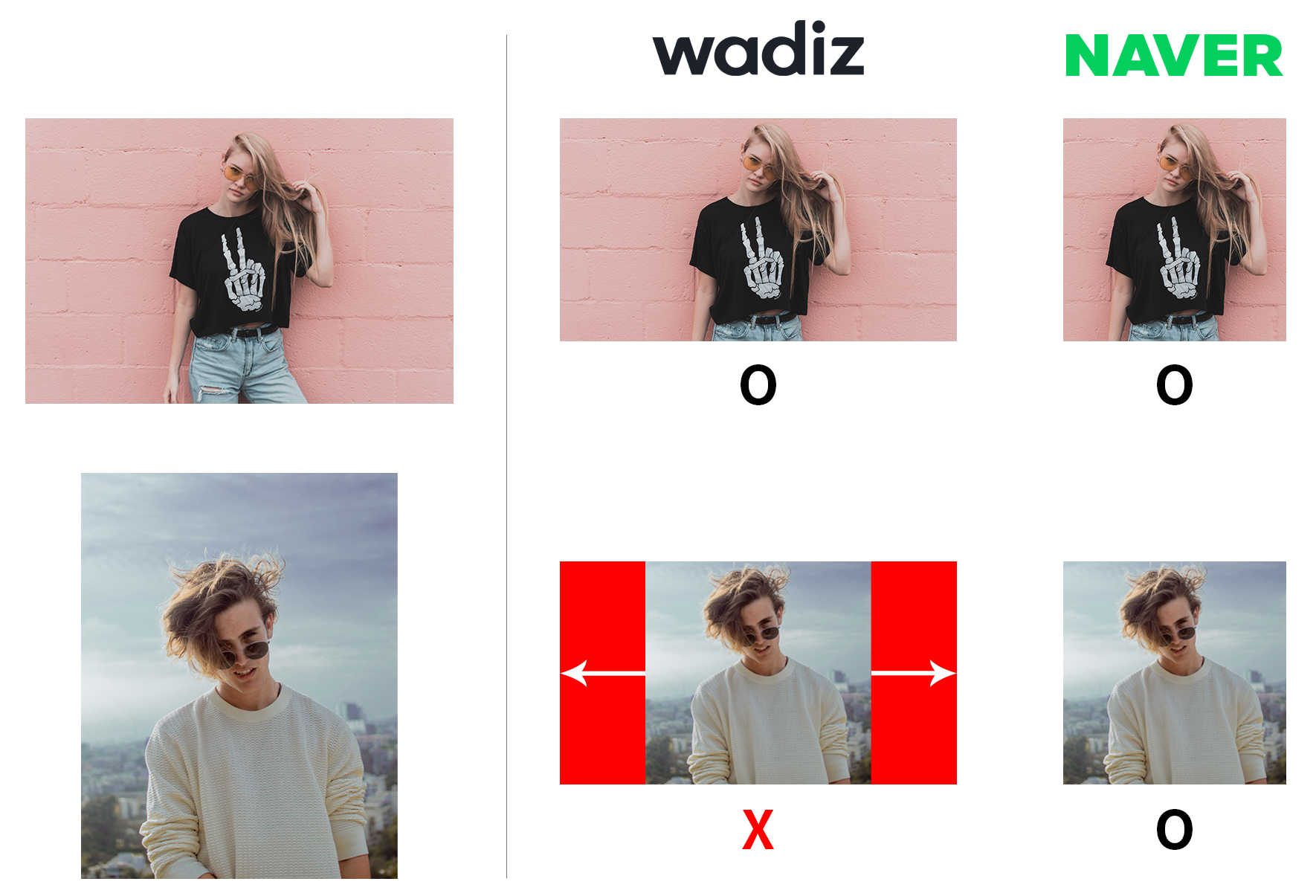
Therefore, before shooting product photos, wemust first determine which platforms we’ll be listing the product detail pages on and check their specific featured image specifications. Even for the same product, we need to set different aspect ratios and compositions for the featured image tailored to each platform before shooting—only then can we capture the “best-looking photo” on-site.
If you skip this step and rush straight into product photography, you’ll end up having to go through a separate editing process when listing the product page because you won’t have a suitable featured image. Most importantly, you won’t be able to select a featured image optimized for that platform’s users, which reduces the likelihood of your product looking appealing and, consequently, lowers the traffic to your product page.
Third, with a minimal budget and time,
you can create the product detail page you want.
If you shoot only the photos and GIFs that are absolutely necessary,
the studio rental time will be correspondingly shorter.
This reduction in time naturally leads to cost savings. Furthermore, instead of buying props based on vague guesses while researching references, you can purchase only those items that will actually be used on set—such as a “fan”— which also reduces your prop budget.
After the shoot, you can also reduce the time spent creating the product detail page.
This is because you won’t have to go through the process of realizing while writing the product description, “Oh, I don’t have this photo. I’ll have to take it with my smartphone,” then pulling out the product, preparing to take the photo, snapping dozens of shots, and spending time selecting and editing the one you need.
Ultimately, you can either shoot more products at once with the same budget and time, or save both the budget and time required to shoot a single product.
Customers will
just because there are too many photos.
In most cases, if there’s only one product, there’s only one product detail page. In other words, we only need to prepare enough photos and GIFs to fill a single product detail page. Any additional files end up sitting on an external hard drive for years under the assumption that “I might use them someday,” only to be deleted when storage runs out.
It’s true that photos and GIFs help customers understand products online. However, customers don’t buy products simply because there are many photos or GIFs.As a product detail pageplanner or writer, you should first consider whether the photos and GIFs are what customers actually want to see. Why not practice writing a brief draft of the product detail page before the photo shoot, so you can view the product through the customer’s eyes even on set?
<Content Director’s Column> Series
- [Content Director Column #1] Why Product Detail Pages Need to Be “Detailed”
- [Content Director’s Column #2] The Order of Product Detail Pages: Let Me Just Set It for You.
- [Content Director Column #3] Step-by-Step Guide to Launching a Product Detail Page
- [Content Director Column #4] There’s No Such Thing as a “Women in Their 20s” Target Audience
- [Content Director Column #5] Why You Should Write the Product Detail Page Even Before You’ve Taken Product Photos
- [Content Director Column #6] How to Write a Product Page Summary in 3 Minutes
- [Content Director Column #7] 3 Ways to Boost Sales by Adding Just One More Line
- [Content Director Column #8] How to Instantly Improve Your Product Description by Changing Just a Few Words
- [Content Director Column #9] How to Write Product Descriptions That Let You Charge Fair Prices Amid Price Wars
- [Content Director Column #10] How to Write Ad Copy in Just 10 Minutes Using ChatGPT
Makers, check out the services you need!
- Learn How to Get Started with wadiz projects
- Check out the [Maker Events] currently open for registration
- Sign up for [wadiz funding workshops] led by funding experts
-
Text/Photos/Editing: Choi Hong-hee
This article is an excerpt from “3 Reasons Why You Should Write Your Product Detail Page Before You Even Start the Photo Shoot,”originally published on Fashion Post on October 25, 2021.
※ If you share or use any content (text, images, videos, graphics, data, etc.) posted on the wadiz maker center externally, please be sure to cite the source.